
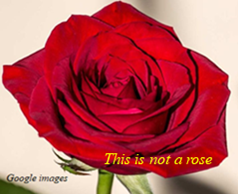
The word rose doesn’t
emulate any colour, no matter
how perfectly read,
it doesn’t carry any sense
of smell either, however
flawlessly the speaker accents.
Fiction · Poetry · New Voices
The word rose doesn’t
emulate any colour, no matter
how perfectly read,
it doesn’t carry any sense
of smell either, however
flawlessly the speaker accents.
You must be logged in to post a comment.
“A rose by any other name would be just as sweet.” In order for us to be on the same page we have to settle on a common set of symbols to represent what we perceive around us. The word rose conjures for me an image of a pink petalled flower that smells of vanilla – because that is how my daughter talks about it. I am on the same page as her.
I don’t get it Supratik. The word rose conjures up such beauty in my mind, colours, smells, sights and an escape from the ugliness of the rest of the world.
always maintained, I could not understand those who could not believe in a superior power on smelling a rose.
You are a deep thinker. I need to know more
Alison x
This originates from Magritte’s series, ‘ceci n’est pas une pipe’, which revolutionized our pattern of thinking; Magritte was criticized but he was later taken seriously because at the end of it all, the image of a pipe wasn’t a pipe because you can’t smoke with the image! The word or the painting which depicts an object is not the object itself. But we have completely got confused; it’s because we are so much sold to the word that we often confuse words with actions, Bhi was close when he quoted Shakespeare, ‘That which we call a rose would by any other name smell as sweet’ but what this poem aims at is much more than Magritte and Shakespeare.
It might sound presumptuous but the lines are trying to say that without action, words do not fulfill their meanings, we see good words being used everywhere, but when it comes to actions, we invariably fail.
You see the word rose may conjure beauty in our mind, but the flower rose doesn’t know its name (don’t know if I am sounding stupid here), we know rose as a rose because we have assigned it a name, but if it were called anything else, it would still be a flower that would be identified with beauty, perfection, and purity. To make things comprehensible, identifiable, this is required, but this need also becomes a crisis, a trap, a major one because it moves us away from taking action.
The intellectual world is much too occupied writing, and fighting with words, it is talking at length about inequality, injustices, and so on, but the ideas (talks) do not convert into actions.
Sometimes, I wonder that if so many people, genuine ones, are talking about the importance of peace and equanimity, why isn’t it coming to fruition? Is it because of the fact that the good world thinks their work gets accomplished with words?
That is why the poem tries to remind us that the flower in question, despite creating a physical imprint in our brain (the signifier and the signified of Ferdinand de Saussure) is not a word.
You are correct, Supratik, “rose” is not a word, it is an abstract concept. The process of placing value onto abstract concepts, because that is what the “world” around us is light being reflected off objects which are not what we see but are “created” by our need to understand.
In critical theory this is studied as reification. This is the tendency for individuals to ascribe a definitive value or form to an abstract concept. It is perceiving or regarding something other than for what it was originally intended. Reification can also refer to the brain’s ability to fill in the blanks when visual information is missing. This process also assigns meaning to abstract or visual images that do not actually exist.
Reification can occur in one of two ways. The first is known in psychology as a fallacy in concrete thinking. This occurs when an abstract belief or concept is treated as if it was tangible or real. The fallacy is the process of assigning a psychological property to an object as if it had its own capabilities.
An example of this would be the phrase ‘you can’t fool Mother Nature.’ The phrase treats nature as a real person, even though we know that it’s not. Another example would be the phrase ‘fighting for justice.’ We would understand that it is an adage for putting a lot of time and effort into making sure a situation is right or fair. However, it could be misconstrued as fighting for a person named ‘Justice.’
In both these examples, there’s no real confusion going on. We understand, of course, that nature isn’t a real person, just like we understand that we’re discussing justice. This form of reification is not confusion for what is real and what is not, but the abstraction of language into tangible understanding.
The Gestalt EffectAnother form of reification is the Gestalt Effect, which is essentially the visual recognition of figures as whole forms instead of a series of lines and curves. The human eye sees objects in their entirety before perceiving their individual parts, which contributes to the famous Gestalt phrase: ‘The whole is greater than the sum of its parts.’ Take a look at this image.
https://study.com/cimages/multimages/16/gestalt-reification.jpg At first, the spikes appear to be poking out of a white ball. However, if you look again it is simply a series of spikes drawn in a white area. Because of the specific shape of the black arrows, your brain is filling in the white space with a ball that’s not there. This form of reification is a construction or generative perception where an object is perceived as having more spatial information than is actually present in the original stimulus.
https://study.com/cimages/multimages/16/1illuscont1_large.jpg Here’s another example. In this white square, just like the orb from earlier, reification gives the illusion of details that are not there. Our minds fill in the gap for the outline of a white square.
In summary we create reality to allow us to make sense of what “is” out there and can only be given shape by our senses.
Just brilliant. Thank you.