
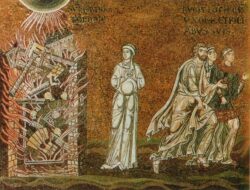
Don’t look back in anger, Edith,
while you are leaving behind
the charred remains of the
ancestral home destroyed
by raging forest fires.
It isn’t the monetary value
of the property that has gone up
in flames, that grieves you
but t the emotional worth of past
family history consumed by oblivion
Your husband , a pillar of strength,
is beside you. That means a lot.
He walks without a backward glance
on parched land, with dryness caused
by rising global temperatures.
Hearing that neglecting to redress
the situation might lead to the demise
of humanity, rubs salt into the wound.
There’s no point looking back at failed
past resolutions; net zero’is needed now.
In the words of the old song… don’t look back in anger, I heard you say. Enjoyed the read. Net zero… it’s a long time coming.
Something to look forward to, maybe on my hundredth birthday?
Luigi, You become one of my favourite poets from today.
Your poem offers advice that is both emotionally compassionate and environmentally urgent. Its central message—that we must grieve what has been lost without allowing grief, anger, or regret to paralyse us—is particularly relevant in an age when climate change is no longer a distant warning but an unfolding reality.
The opening line, “Don’t look back in anger, Edith,” immediately establishes an intimate, consoling voice. Addressing Edith by name transforms the poem from a general environmental statement into a personal encounter with loss. The ancestral home represents much more than property: it embodies family history, inherited memories, and the emotional continuity between generations. Your distinction between monetary value and emotional worth is therefore essential. Buildings can be reconstructed, possessions replaced, and land restored, but the memories associated with a place cannot simply be recovered.
The presence of Edith’s husband, described as “a pillar of strength,” introduces another important dimension. In moments of devastation, human companionship becomes a form of emotional shelter. His refusal to look back may be interpreted not as indifference to the past, but as a determination to continue living despite it. The poem thus offers a humane lesson: acceptance does not diminish the significance of loss; it enables us to move beyond it.
The transition from personal tragedy to global responsibility is particularly effective. The charred ancestral home becomes a microcosm of a planet threatened by rising temperatures and increasingly destructive fires. By invoking the possible demise of humanity, you enlarge the poem’s moral horizon. The suffering of one household becomes inseparable from the consequences of collective inaction.
Yours
Supratik
The concluding lines deliver the poem’s strongest advice: “There’s no point looking back at failed / past resolutions; net zero is needed now.” The urgency is unmistakable. Regret over previous failures must give way to meaningful action. However, the poem does not suggest that the past should be forgotten altogether. Rather, its implicit wisdom is that remembrance must become responsibility.
The poem’s deepest message is that grief should awaken us, not immobilise us. We cannot undo every loss, but we can determine what we do next. Its advice extends beyond climate change to life itself: honour what has disappeared, cherish those who stand beside you, and act before tomorrow becomes another occasion for mourning.
Thank you for your accurate and in-depth analysis. The main message is indeed about the need to find urgent solutions to the dangers of climate change.
The poem was inspired by reading about valuable properties being destroyed by forest fires caused by droughts and climatic conditions. Those incidents brought to mind the analogy of the destruction by fire of the biblical city of Sodom with Lot’s wife, named Edith in Jewish literature, turned into a pillar of salt for looking back at the burning ruins, even though commanded not to do so. I have scattered references throughout the poem.