Someone else held the ticket.
The seat too tall, the buckle’s ache,
the couplings knocking under the floor,
and no one said where we were bound.
They took the child’s fare out of the housekeeping.
Nobody told me. I was luggage.
My father got down at a town with two platforms and a clock that was wrong. He put his hand flat on the window and I put mine on the other side of the glass, and the train went, and I thought that was just a thing trains did. I have been told since that I could have cried out. I was six. I am still not sure that is a regret. It is the first one I know the shape of, and every one after it is that shape.
blossom at speed
the buckle
too high for him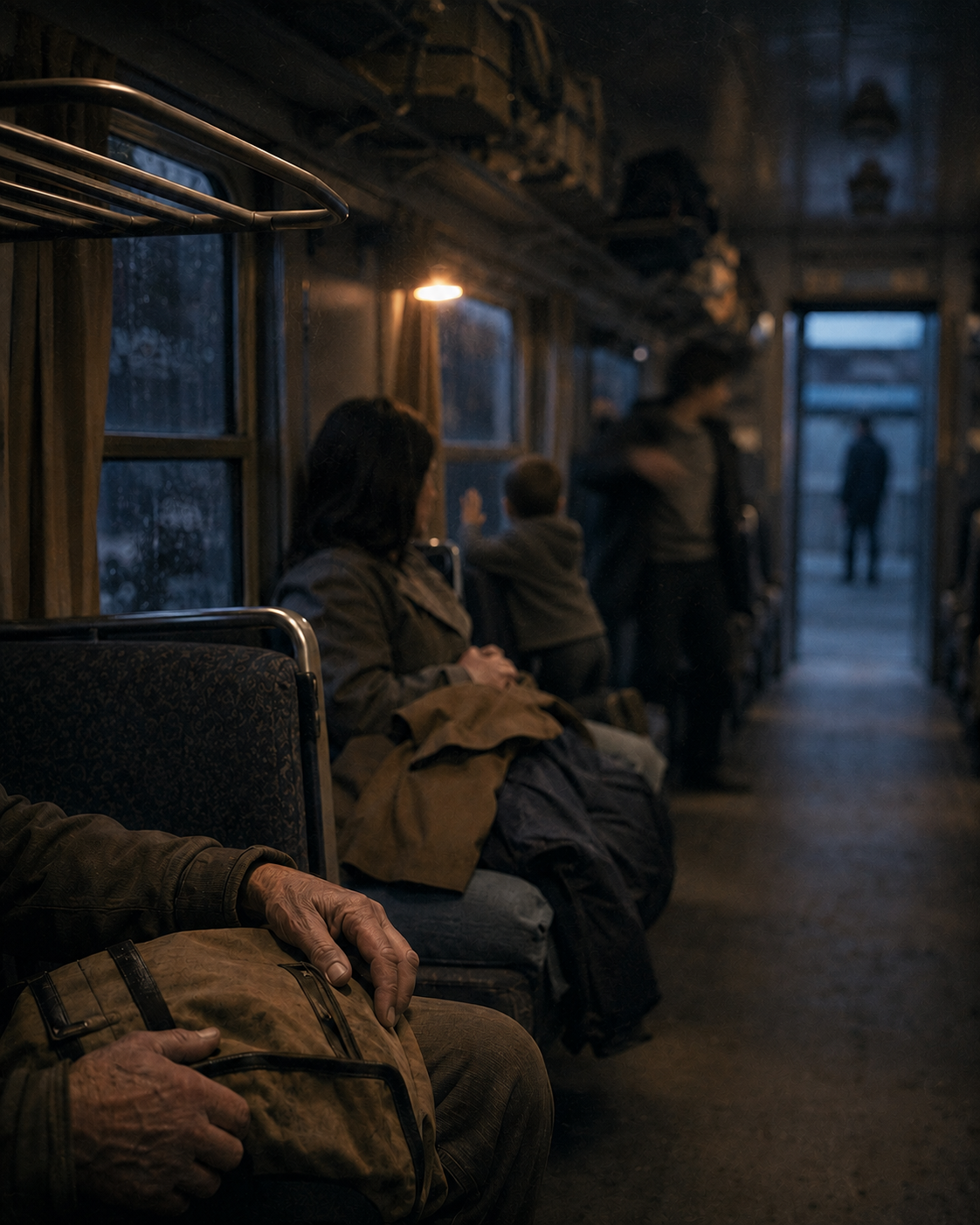
At fifteen I loved the going, not the arriving.
We hung from the door between the carriages,
the wind took the town names from our mouths
before the towns could hear them said.
The towns took it anyway.
Loose change. Nobody counts change in July.
She stepped down at a stop I did not bother to read and I waved from the window like a man waving from a poster. There were eleven of us in that carriage and I could not have told you which of them mattered. The motion was doing my thinking. Forty years on I can give you the exact sound of her shoes on the platform and not the name of one town we shouted at.
cicadas all night
coins loose in a summer coat
nobody counts them
Then the middle years, loud with everything,
the rails going ta-ta under the talk,
the tannoy swallowing half of every name,
and I stopped hearing it, which is how you stay.
Others got down. A man with nothing to carry
stepped off at the first stop he disliked,
and I hated him for the lightness of it.
A woman opposite rode fourteen years
past her station, two of them on her ticket.
Twice I stood, my hand on the cold rail.
Twice the door held its breath and let it go.
By then the fare was a house, a lease, a job.
Still payable. I did not ask it aloud.
I knew which stop had the bad coffee and not which one was mine. Twelve years in a building I could describe with my eyes shut and could not tell you the purpose of. The first time, what stopped me was that stepping down is a sentence you have to say out loud, and the sentence is: I was wrong, and I have been wrong for a while, and I knew. The second time there were two other fares in my pocket that were not mine to spend. I have spent thirty years letting people think both times were the same time, because cowardice and duty look the same from the platform, and only one of them lets you sleep.
shortening light
a hand on the rail
the fields go on
Here is the part nobody tells you. The regret is not for the towns. It is that I was a passenger in a thing I had a ticket for. And I still do not know whether there was a stop with my name on it, or whether I made that up so the standing up would mean something. The door opens. That much I am sure of. It opened all day, and it opened wider for some of us, and I cannot tell you from in here which kind I was.
Now the glass gives me back my face
with weather behind it.
The fare is a life. I checked.
My knees hurt and the heating is too high.
So. Practical things. Coat on.
Bag off the rack and onto my knees.
I have stopped watching the fields.
I am watching the door.
snow at the halts
the rack
empty