
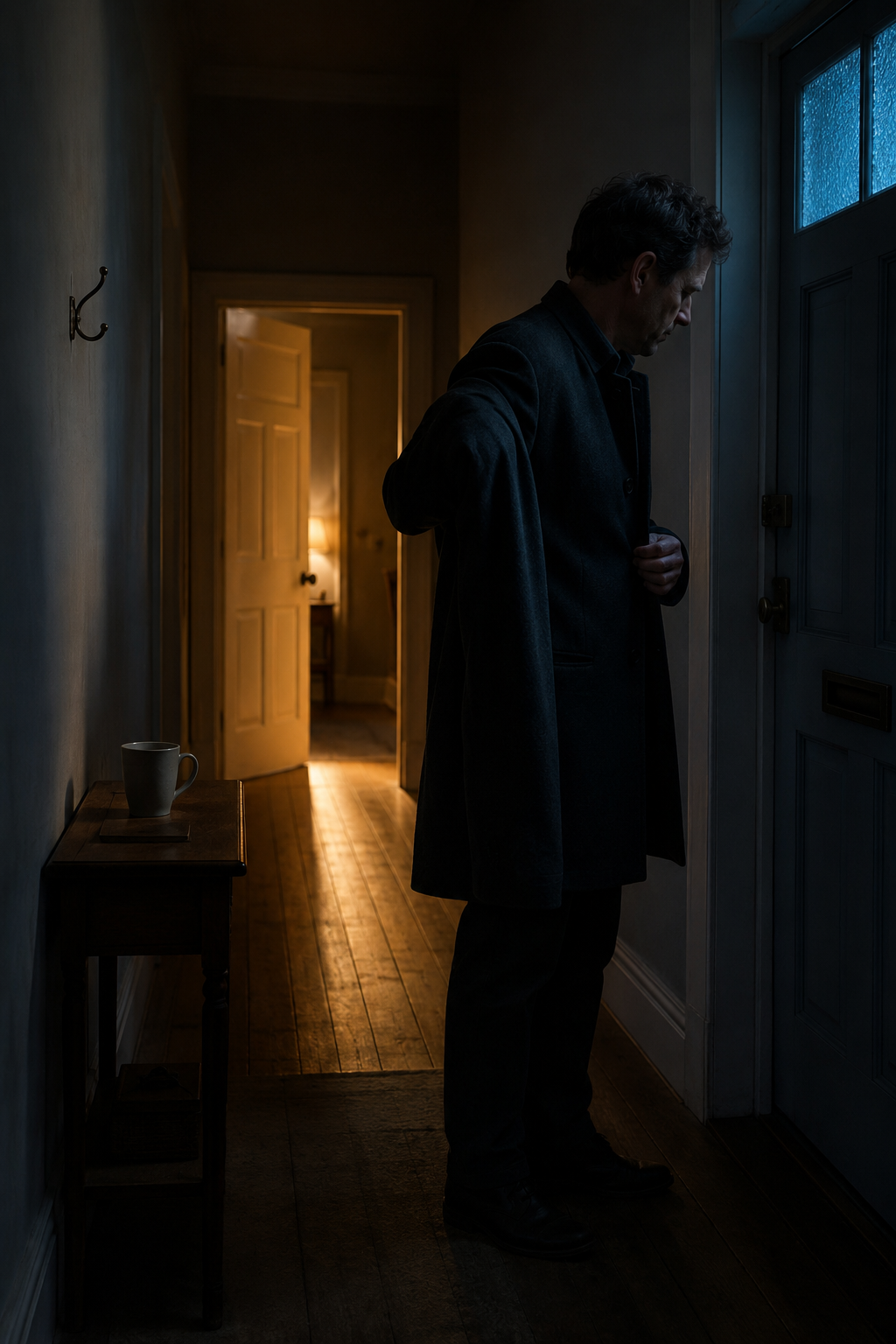
Lay your hand one more time.
I have carried a stranger down a street,
a grown woman, both arms under her,
and felt only the walking.
The other weight showed. That was the point.
I went first through every door,
and whoever goes first through the door
never gets met on the other side.
It went on a bad year at a time,
hammered flat, hammered home,
worn to the table, worn to bed,
worn through a wedding and a funeral,
worn so long the shoulders
grew to fit the buckle.
She put her hand on my shoulder.
A small hand. It knew where the buckle was.
Not lifting. Just there.
And the rig came off me
the way a coat comes off indoors.
Some winters strip a man to the bone.
Some are a log fire and a full room
and a roof that does nothing worse than moan.
Either way the coat goes back on
before the door.
There is no weight in it at all.
It is a door opening somewhere else in the house
and the cold coming off the room in February.
It is a window found on the shaded side
at the worst hour of August.
Listen. Before I build her the monument, and I will,
she would have laughed at the height of it.
She could go three days without using my name
and mean every hour.
There were nights the hand did not come.
The rig stayed on in bed.
A cup went cold on her side of it
and neither of us was in the wrong.
That is a union, not the thing they print on the cards.
Hers never showed. That was the craft.
She held the scales, and whoever holds the scales
has to stand level herself.
She could cross a floor like a dancer,
turn at the end of it into the thing
that stood between the house and whatever came,
be a mother again by the stairs,
and a boy about a joke at the table.
And that small hand was what was left
when all of that was done.
Twenty four years,
then a house that kept its temperature
and lost its weather.
Somewhere tonight a man sits
in a car park with the engine off,
not going in yet,
still buckled,
ticking as it cools.
KJS
A good read, KJS
This is a mature and restrained poem of love, marriage and grief. Its greatest achievement is that it avoids the conventional vocabulary of mourning—flowers, tears, angels, eternal declarations—and instead creates its elegy through silence, domestic detail and remembered gestures.
The opening immediately establishes the poem’s governing tension: “Before I build her the monument, and I will, / she would have laughed at the height of it.” The grand idea of a “monument” is instantly humanised by the woman’s irreverence, suggesting that the poem itself will become her true memorial.
The portrayal of marriage is particularly convincing. “There were nights the hand did not come” and “A cup went cold on her side of it / and neither of us was in the wrong” beautifully recognise that intimacy does not require constant closeness. “That is a union, not the thing they print on the cards” becomes an understated redefinition of marriage—complex, imperfect and real.
The metaphor of balance is superb: “She held the scales, and whoever holds the scales / has to stand level herself.” It captures the invisible labour of sustaining a family, while “Hers never showed. That was the craft” reveals how effortlessly she concealed that labour.
The characterisation is equally economical. She is dancer, protector, mother and playful companion, yet “that small hand was what was left / when all of that was done.” The enormous presence of the woman is reduced to one vulnerable physical detail.
The ending is exceptional: “a house that kept its temperature / and lost its weather.” The house remains functional but has lost its emotional climate. Finally, the bereaved man sits in his car, “still buckled, / ticking as it cools.” Grief is never named; it is embodied.
A few phrases—“mean every hour” and “The rig stayed on in bed”—are deliberately enigmatic and may momentarily slow the reader, but their ambiguity also contributes to the poem’s intimacy.
Overall, this is adult grief rendered without sentimentality. The poem’s restraint is its greatest strength: it does not tell us what grief feels like; it makes us inhabit it.
You’re
SS
Supratik,
Thank you. You’ve read it as it was written. She’d have laughed at flowers and angels too, so the poem had to do without them.
The two phrases you flagged: “mean every hour” was her standard, not every day but every hour, because a day is easy and an hour is where it’s tested. “The rig stayed on in bed” is the armour you can’t take off even beside the one person you trust. Hers came off. Mine mostly didn’t. That imperfection had to be in there or it would have been another card.
The car is still the only room that never learned she was gone.
Grateful for the close read.
Kevin
*yours ss