
The work
Two pieces holding the same argument from opposite ends.
Attrition is a sequence of sixteen incidents. A shout in the wrong direction. A card from the head of state on a windowsill. A soldier who put his hands out. A chair moved nearer the window and then turned to face the room. Each one is an event, good or bad, and each one wakes something that could not have been taught.
The Receipt is the thesis those incidents are evidence for. That certain judgement is acquired only through exposure to consequence and cannot be transferred by instruction. That duration is the ordinary delivery mechanism and not the only one. That survival is mostly luck, which does not weaken the case. That the contempt aimed at the old tracks proximity to death rather than capability, and that the invoice the young present is a separate and largely justified matter. And that none of it resolves, because the education is bought with the only currency it teaches you to spend, and it is complete at the moment there is least of it left.
The poem is the paradox. The essay proves it. Neither of them wins.
Part One
Attrition
in incidents
The Two Statements
He said: this is only the start of my success.
I said: I have lived this long to pay for my sins.
The Handle
He is twenty-seven and he buys the drinks, which is how I know what is coming. He tells me he is successful and waits. I ask him how, and he says luck, then corrects it to something longer that still means luck. A father. A door that happened to be unlocked on the one morning he tried the handle.
And this is only the start, he says. This is nothing. Wait.
Then he puts the glass down. You hold the houses. You hold the seats. You voted for a century you will not attend.
And he is right, and I had not expected it, and I learn in a bar on a Thursday that there are two arguments arriving in the same voice. One is with what I own. The other is with what I am, and only one of them is mine to answer.
No Signal
Nine years in a hall with a wooden floor. Forms, belts, gradings, the whole architecture of it, and I was good, and I knew I was good, and I had decided somewhere around twenty that I was a defender, which is a flattering word for a man who has never yet been surprised.
He was nothing. That is the honest word. A runt. A scrapper. Sixty kilos of nobody and I had filed him before he reached me.
There was no signal. No squaring up, no chin lift, no let us see then. He did not start, because starting is a courtesy and he had not come to be courteous.
He took my ear in his teeth. He put his thumbs where my eyes were. He had my head against the wall before I had finished deciding to begin.
Everything I had ever been taught assumed there would be a beginning. He simply arrived already doing it.
I have never been beaten like that since, and it is not because I got better.
The Door
Four in the morning. Strip light. Hand gel and warm plastic. A cardigan over the back of a chair because the ward is cold and she has been here since Tuesday. A vending machine two doors down that I will remember for the rest of my life for no reason I could give you.
The nurse comes out and says nothing. She holds the door a fraction longer than a door needs holding.
I knew. Instantly, without being told, and I had not known an hour before, and I have known it every time since. That is the whole lesson. Nobody set it. Nobody marked it.
Oi
Halfway across, and behind me a shout. One syllable. Oi.
And I turned on it, ready, because I was young enough to hear a shout as an insult and slow enough to stop walking while I decided.
The cars met where I had been standing. The sound of it came through my chest before it reached my ears, and there was glass in the road for a week afterwards in the gutter, being swept a little further each day.
The old man was drunk. He was shouting at nobody, or at somebody in a different year, and he never once looked at me, and he had gone by the time I understood.
So I am here because a drunk made a noise in the wrong direction. He did not save me. He was not talking to me. There is no one to thank and nothing in it that I did.
The Card
On the windowsill of a room in a home there is a card from the head of state. Gold edge. Printed signature. A hundred years of continuous good conduct and here is the certificate to prove it.
Nobody in the building says the obvious thing.
In every other custodial arrangement on earth behaving well gets you out early. Here they send a card and add another year to the term.
The Release
The coffin is short enough to carry under one arm and the church is full, and every one of us is standing there in our own good clothes mourning the only person in the room with no case to answer, who was out through the gate before the paperwork was typed and is loose now in the entire width of the universe
while we file back to the cars and queue at the junction and comply, and comply, and comply.
I have never said this aloud to anybody. It is exactly what a lifer sounds like watching somebody walk.
The Extension
He is twenty-four and has signed three this week and thinks that makes him old. It nearly does.
The old man in bay four talks to him at two in the morning because he is the only person in the building holding a hand instead of a phone, and the doctor learns more in eleven minutes than in the theatre he paid nine years to sit in.
Then the consultant signs the extension and the bed is four thousand a night plus the room and the sentence runs on past anybody’s need and we call it care and we thank him for it, and nobody at any point in the whole procedure asks the man in bay four whether he had been hoping to get out.
Not His Fight
An Irish bar. Two men, and one of them going down and staying down and still going down, and a third man who was not in it put his hands out and stepped between them, which is the whole of what he did.
The glass came from the side. From a stranger. From somebody who was not in the fight either, who had no name in it and no part in it and did it to a man’s neck in less time than it takes to say so.
Nobody could hold it closed. Somebody’s coat went under his head. The room made a noise I have not heard since and I have been in rooms.
There was a reason, afterwards. It had nothing to do with the fight.
He was a soldier. That is the whole of it. Not what he did in the room, which was to put his hands out. Not what he did anywhere. What he was, in a bar that had been waiting for one of him.
So the fight was never the reason. The fight was the cover. Somebody else’s argument held a door open for four seconds and a stranger came through it carrying something he had been carrying for years.
He would have done it at a bus stop. He needed a room where nobody would be looking, and two men who had never met him built him one.
The Correction
Fifty-one years married, nine months widowed, and she says it was the Tuesday, not the Wednesday, and stops, because the only other person who could confirm it is the reason she is in the black coat.
She holds the record of two lives now and half of it can no longer be checked. It does not stop being true. It stops being verifiable, which is a different thing and feels worse, and slowly it becomes a story told by its last remaining shareholder who cannot say which parts have drifted.
She lost him in March. She has been losing the other one since, and nobody has counted that at all.
The Wedding
The chairman is seventy-eight and dances badly and the table laughs. The cleaner is seventy-eight and dances badly and the table laughs the same length of laugh.
She holds nothing. She blocked nobody. She voted for none of it and is on a waiting list.
Later the chairman’s son dances, forty-five, holding the identical assets, blocking the identical promotions, and nobody laughs at all.
So the bill goes to what a man owns and the laugh goes to what a body looks like, and she pays the first for him and takes the second on her own.
The Queue
She is in front of me at the post office and she says, before anything has failed, before a single thing in the day has gone wrong, I am too old for this, at my age, past it now, and she says it first so that nobody else gets to say it.
The man beside her, same age, same chart, never accepted the description and is still walking to town on Fridays.
We put that sentence in her at seven. She handed it back at seventy. Then she finished the work herself, which means every demand I make of the young that does not begin here is not an argument. It is a request.
Two Twenties
The same week they told him to wind down, his grandson started school.
Twenty years in front of the boy and everyone at the table said the word future and bought him shoes and a bag and a coat too big.
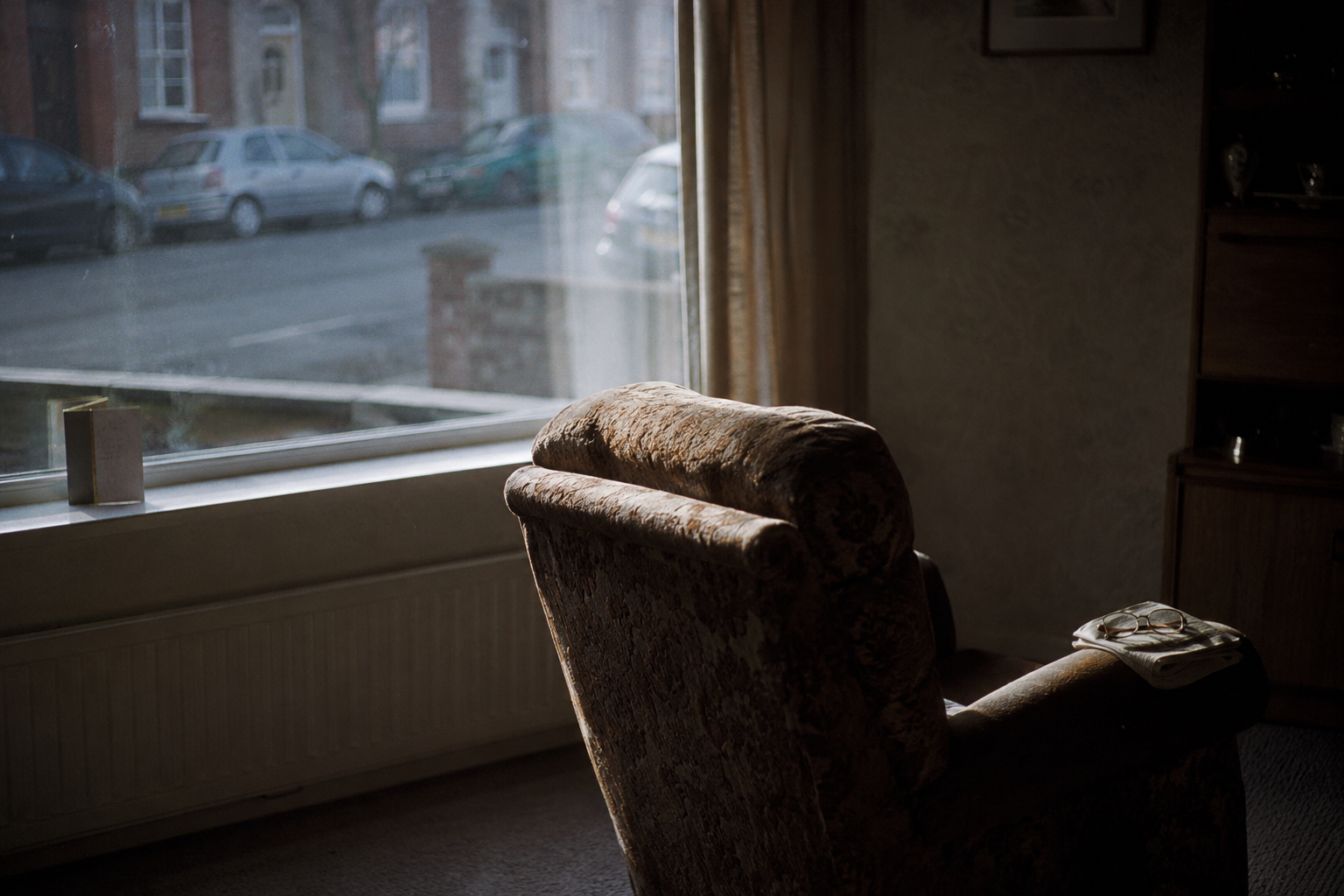
Twenty years in front of the man and everyone at the table said the word comfortable and moved his chair nearer the window.
Same span. Same arithmetic.
A coat bought too big so he can grow into it. A chair moved close enough to see out of.
The Chair
From that chair he can see the whole street, which nobody intended when they moved it.
He knows the neighbour’s belt is going by the sound the car makes at the corner. He knows which curtains open late now and which of them stopped opening in February. He watched the boy grow into the coat across four autumns, sleeve by sleeve.
And on the Tuesday the delivery van reversed he was the only person on the street in a position to see the child behind it, and he was through the door and shouting before the mother had got out of the kitchen.
He does not remember the kerb. He remembers being on the kerb, the child’s hood bunched in his fist, the driver’s face in the mirror, then the pavement coming up sideways and something in the hip letting go with a sound he heard from the inside.
They said thank God he was sitting there. They said it twice, at the door, still shaking.
By the Friday it was a different sentence. He could have gone under it himself. He is not steady. He should not be near the road.
On the Sunday, while he was asleep, they moved the chair back from the glass. Away from the draught, they said. It now faces the room. He cannot see the corner from it, or the curtains, or the coat, or the van.
He has not mentioned it once, because the afternoon he proved he still had it is the afternoon they took the window, and he is not going to hand them the second thing by complaining about the first.
Lunch
Somebody asked him once if he knew when.
He was a hundred and four. He said soon.
Then he asked what was for lunch.
No Win
There is no win in this. I have looked.
If I say the years made me, I am claiming credit for a drunk who shouted in the wrong direction at somebody who was not me.
If I say the years cost me, I am asking to be pitied for the only thing I have that he does not, by a boy who may not get twenty more and does not know it, and whom I would not swap places with even now, even knowing the arithmetic, which tells you everything about what I actually think and nothing I am willing to say to his face.
He is not wrong. He is at the start of something. I am not wrong either.
He said this is only the start of my success and he meant it as a beginning, and he was describing years he has not spent.
I have lived this long to pay for my sins, and I meant it as a sentence, and I was describing the same years, spent.
Nobody arbitrates this. There is no panel, no viva, no result posted on a wall. He goes home to a flat he will own something of by fifty and I go home and turn the light off and neither of us has won anything, and one of us will find out first and will not be able to tell the other.
So I will say the true thing once, here, where he cannot hear it, and then I will never say it again:
I would not give a single year of it back. Not the road. Not the wall. Not the ward. Not the church. Not the window they turned around. Not the door held a fraction longer than a door needs holding.
I have lived this long to pay for my sins, and I would do the whole sentence again.
Part Two
The Receipt
On exposure, survival, and the education that will not compress
1. The paradox in one sentence
The only thing that produces the judgement a society claims to value is the same thing that society treats as disqualification, and it can be acquired by no other means, and it is destroyed entirely at the moment it is complete.
Everything below is evidence for that sentence.
2. The claim, and what would disprove it
Two beliefs are held at once by almost everyone, and they contradict each other.
The first: an older person has less time remaining. True, trivial, arithmetic.
The second: an older person is diminished, less capable, less relevant.
The contradiction sits in what the first belief actually demonstrates. Death is not scheduled and is not distributed politely by age. Infants die. Teenagers die at speed, in numbers, precisely because they believe they cannot. Adults die mid-sentence and mid-mortgage. To have reached seventy, or ninety, or a hundred and four, is to have avoided every mechanism that selects continuously and without notice.
Here is the claim, stated so that it can be attacked:
Certain categories of judgement are acquired only through repeated exposure to consequence, cannot be acquired through instruction, and are therefore unavailable to anyone who has not yet been exposed. Duration is the ordinary delivery mechanism for that exposure. It is not the only one.
That last sentence is the concession that keeps this honest and it is not decorative. A twenty-four year old in an emergency department has watched more people die than most people manage in sixty years. A war photographer at thirty-one has had the syllabus delivered in four years at high compression. They have it. Their birth certificate is irrelevant.
What would disprove the claim: evidence that the relevant judgement transfers reliably through instruction alone to people who have not been exposed. It does not. Every institution that has tried, from surgical training to military selection, ended up building simulated exposure instead, because it could not find a way to simply say the thing.
One dependency must be declared, because the whole argument rests on it. This holds only in a world where nobody knows their date. Age functions as a proxy for remaining term, and it is the only proxy available. Publish the actual dates tomorrow and age is discarded within a week; the world would re-sort itself by remaining term and a robust ninety year old with eleven years left would outrank a thirty year old with two.
That is not speculation, because the natural experiment already runs. People with a known short term exist. They are treated precisely as the old are treated, at any age: written off, spoken over, excused from the future, discussed in the past tense while still in the room. A thirty year old with a terminal diagnosis receives the complete ageist package at thirty, the day the prognosis is given and not a day before.
Which establishes what the prejudice is actually tracking. Not capability, not wrinkles, not decline. Proximity to death. Everything else in this essay follows from that.
And it is tracking it badly. At sixty-five the remaining expectation runs to roughly twenty years. That is a longer span than birth to leaving school, a period every society on earth treats as vast, formative and worth its entire education budget. The same twenty years, arriving at the other end, is filed as a coda. Nobody has ever explained why the second twenty is a waiting room and the first twenty is a foundation, because nobody has ever been asked to.
3. The syllabus
A corridor at four in the morning, strip-lit, smelling of hand gel and warm plastic. Somebody’s cardigan over the back of a chair because the ward is cold and she has been here since Tuesday. A vending machine two doors down that you will remember for the rest of your life for no reason you can name. And a nurse coming out and not saying anything, only holding the door a fraction longer than a door needs to be held.
Nobody teaches you what that fraction means. You know it instantly, and you will know it every time afterwards, and you did not know it an hour ago.
At twenty, a life has consisted overwhelmingly of childhood and adolescence. The person has been fed, housed, schooled and supervised. They may be formidably intelligent. They have not been examined, because nothing has yet been at stake that they were not certain to survive.
The examination begins with death, and it arrives in a sequence.
The grandparents, on schedule, almost politely. Then a parent, which reorders everything and permanently changes the shape of a room. Then somebody your own age, out of order, which withdraws the last of the invisible guarantee. Then the accumulating awareness that the sequence contains no rule protecting you and never did.
Nobody sets this. It cannot be assigned or accelerated by effort. What it produces is not knowledge. It is recalibration: what registers as an emergency, what registers as noise, how long you are prepared to wait, what you will no longer spend a year on.
This is why the exchange between young and old so often fails. The young ask for a summary. There is no summary. The content is the exposure.
4. Bounded consequence and unbounded consequence
The caricature has to go first, because it is the weakest thing anybody in this argument reaches for.
The doctorate is genuinely rare. Around two per cent of adults in the developed world hold one, and roughly four point seven million in the United States as of the last full count. It is also genuinely hard to obtain, and not primarily in the way people assume. The best available longitudinal data puts ten-year completion at about fifty-seven per cent, meaning something close to forty-three per cent of everyone who starts does not finish, after years already spent. That is not a soft process. Isolation, dependence on one supervisor’s continued goodwill, funding that can be withdrawn, and a documented level of anxiety and burnout that the sector has stopped denying.
So concede it plainly. Completing a doctorate is an exposure event. Anyone who finished one has been through something.
The distinction this essay needs is therefore not hard against easy, and not clever against wise. It is this:
Bounded consequence has an appeal process. Unbounded consequence does not.
Inside the academy, failure is a rejected paper, a lost grant, a delayed viva, a supervisor who leaves. Every one of those is recoverable, contestable, reviewable, and absorbed in part by an institution whose function is to keep the person in place while they recover. The downside is carried by somebody else, by design, and that design is correct: it is exactly what allows deep work to happen at all. Nobody solves a hard problem in ten years while worrying about the rent every month.
Outside it, the same person’s judgement is called upon in conditions with no reviewer, no appeal, no institution absorbing the loss, and no second submission. The business that fails, the family that has to be moved, the decision taken at four in the morning with the wrong information and no time. Nobody marks it. The result is simply the result.
These are different training environments and they produce different instruments. One produces depth, method, and the ability to be right about something narrow in a way almost nobody else can be. The other produces the judgement this essay is about. Neither substitutes for the other, and the person who holds one is not equipped in the other merely by being intelligent.
Then the actual error, which is society’s rather than anyone’s personally, and which runs in both directions.
We take the authority of a narrow credential and extend it to general judgement, which is why a specialist is asked on television about matters entirely outside the specialism and answers. And we take a person whose only qualification is fifty years of unbounded consequence and grant them authority over nothing at all, including their own affairs, increasingly, as they age.
Both are the same mistake. Rarity is being read as general superiority in one case and duration is being read as general decline in the other, and the two errors reinforce each other perfectly.
Two further notes, in fairness.
The financial folklore also needs correcting. Doctorate holders earn well on average; the median is high. What is true is that the variance is enormous, that the outcome depends almost entirely on field, that the tenure-track positions the training points toward absorb only a small fraction of graduates, and that several years of low stipend income arrive precisely during the years when earnings and investment normally compound. The degree is not a poor decision. It is a decision whose returns are far less uniform than its prestige implies.
And the risk profile is a genuine difference rather than a character flaw. A funded, supervised, low-variance environment selects for people who work well in it, and it should. The error is only in what we conclude from the result. Nothing about surviving forty-three per cent attrition tells you how somebody performs when there is no committee, and nothing about running a household through two currency collapses tells you how they would perform in a laboratory. We keep insisting one of these predicts the other, and it does not, in either direction.
Against the credentialed man, then, set a person with no qualifications who reached eighty-five, raised children, buried people, kept a household solvent through three currencies and two governments, and adapted every decade to a world that never consulted them. They cannot cite a source. They made decisions under unbounded conditions with unrecoverable consequences and were not removed from the board.
There is a known mechanism underneath this and it deserves one sentence. Processing speed and working memory decline with age; accumulated pattern recognition, vocabulary and situational judgement do not, and in many people continue rising into the seventies. The popular model of ageing tracks the first half only and reports it as the whole.
5. Survival is mostly luck, and this does not weaken the case
The argument collapses if it will not make this admission.
The wire does not check your record. The bus does not read your file and swerve. The fever does not assess your character. A large fraction of everyone who died young was more careful, more capable and more deserving than a large fraction of everyone who did not.
So the older man who dismisses a young man’s success as luck must accept the same instrument turned around. His own arrival is luck. It has simply been running longer.
The two are not symmetrical, and this is where the young objection fails. Luck is a necessary condition for survival and not a sufficient one, and it is not the thing under discussion. Nobody claims the survivor earned the bus missing. The claim concerns what accumulates during the survival, which is not luck, is not distributed by intelligence, and is destroyed completely on the day the luck ends.
The luck buys the years. What happens inside them is the only item on the table that was ever anybody’s own.
6. An unserious proposition, offered seriously
Consider, with no evidence whatsoever, that the length of a life is a sentence.
None of us was shown the charge. No plea was entered. The term runs to natural life and the conditions are non-negotiable. Good conduct does not reduce it. Good conduct extends it, which is the detail that should have alerted us long ago: in every other custodial system, behaving well gets you out sooner. Here, the model prisoner is rewarded with a hundred and four years and a commemorative letter from the head of state, and the difficult ones are released quietly at forty for the good of the institution.
And then the detail that turns the joke into an argument. A prisoner is told his release date. He can count. He can plan for the morning after, write to somebody about it, decline to start anything that will not finish in time. We are told nothing. The term is fixed and undisclosed, which makes this sentence harsher than any custodial term ever handed down by any court in history, and it is served by everyone, and no one has ever appealed it.
The infants go first. No case to answer, no paperwork, straight out through the gate and free in the entire width of the universe. And we, still inside, filing, queueing, complying, attend the funerals of the acquitted and call it a tragedy.
Which is exactly what a lifer calls it, watching somebody walk.
The conceit is absurd. Notice what it exposes.
We have no coherent account of why length is good. We mourn the child because the years were taken and we congratulate the centenarian because the years were granted, and both statements cannot be true unless the years themselves contain something. If duration has content, then the death of a child is a loss because nothing was acquired, and the death of the hundred and four is a loss because everything was, and the second loss is larger and is the one nobody counts. If duration has no content, the whole apparatus of mourning is theatre and the child was simply released early.
The satire only works because we secretly measure life by duration while publicly insisting we measure it by something else. Pick one. The rest of this essay picks the first and accepts the consequences.
7. The parole board
Follow the conceit one step further, because it lands on a real institution.
Somebody has to sign the extensions.
A doctor at twenty-four has three deaths in a week and thinks that makes him old. It nearly does. He has the syllabus early and at volume and he will receive the rest of it: the ones out of order, the ones at speed, one or two carrying names the country recognises. He will also meet the old, who will talk to him, because he is frequently the only person in the building holding their hand rather than his phone. He will learn more at those bedsides than in any theatre he paid to sit in, and nobody will examine him on it.
Then there is the other road. It is better lit and it pays.
Extension is a product. It has a price, a margin, a bed rate and a billing code. A system that is paid to continue a life and is not paid to conclude one will, over time and without anybody choosing it, continue lives past the point of anybody’s need, and will call that care, and will be thanked for it. The sentence is run on at four thousand a night plus the room, and the prisoner is not asked whether they had been hoping to get out.
And there is a harder version of the paradox sitting inside the accounting. The largest single share of a person’s lifetime medical resource is spent in their final eighteen months, buying time that almost nobody is in a condition to use. Across the thirty years before that, when the same money would buy years that could be spent, the spending is a fraction of it. The money follows the end. The respect never arrives at any point.
Two fairness notes, because the accusation is serious.
Most clinicians do not take that road, and many spend their careers fighting the machinery that pushes them down it. And the pressure very often comes from the family rather than the physician, because the family cannot carry the decision and the institution is willing to sell them a way of not making it.
That does not weaken the point. It locates it. The greed is structural before it is personal, which is precisely why it is so hard to see and so profitable to leave alone.
8. Two mechanisms, and only one of them is prejudice
The hostility directed at the old is not one thing. It is two, they arrive together, and the failure to separate them is why every conversation about this collapses within a minute.
8a. The flinch
Watch what happens when an older person visibly enjoys themselves. Dances badly. Dresses without asking. Starts something at sixty-eight. Somebody will say they are too old for that.
The remark is not an evaluation of the old person. It is a claim by the speaker: I am not in that category, and I hold a guarantee that I will arrive there in good order.
Nobody holds that guarantee. The mockery is a defence against a fact the speaker cannot hold steady, which is that they may not arrive at all, and that if they do, it will be them dancing.
That explains the quality of the contempt. It is reflexive, poorly reasoned and disproportionate to anything the old person has done, because it was never an assessment. It was a flinch.
It also has an inconvenient timestamp. The negative associations are measurable in children at seven or eight, well before anyone is competing for a house, a job or a seat on a board. Whatever this is, it is installed long before there is anything to be angry about.
8b. The invoice
The second mechanism is not prejudice at all, and pretending otherwise is the weakest move available to anyone my age.
A nineteen year old looking at the current arrangement sees a cohort holding the housing stock, the boards, the senior seats, the electoral majority and the pension guarantees, having voted repeatedly for outcomes that arrive after their own departure. He is not making a claim about capability. He is presenting a bill.
That grievance is materially real and substantially correct, and hostility toward power is not a prejudice, it is politics. Any essay that files it under bigotry so it can be waved away deserves to lose the argument, and would.
8c. Telling them apart
The two mechanisms are distinguishable, and the test is simple.
Change the target’s power and see if the contempt moves.
A seventy-eight year old chairman and a seventy-eight year old cleaner receive the same eye-roll for dancing at the same wedding. The cleaner holds nothing, voted for nothing, blocks nobody, and is on a waiting list. She gets the full package anyway. That contempt is not tracking power, because power is absent.
Run it the other way. A forty-five year old chairman blocking the same promotions and holding the same assets receives the invoice in full and none of the flinch. Nobody laughs at him for dancing.
So: the invoice tracks holdings, the flinch tracks bodies. They are separate, and the injustice sits in the overlap. The elderly poor pay the invoice run up by the elderly rich, and are handed the flinch on top, and possess neither the assets that provoked the first nor any defence against the second.
The correct response is to answer the invoice politically and refuse the flinch entirely, rather than the usual manoeuvre of answering both with a lecture about respecting elders, which concedes the argument and earns the contempt fresh.
8d. What the market already admits
There is a ninety billion dollar industry dedicated to removing the appearance of age, sold to people competing ferociously for more years of life. Both facts hold at once and they are not in tension.
Nobody is rejecting the years. Everybody wants the years. What is being rejected is the announcement of them, because the announcement arrives well before any decline it claims to report, and once issued it is never withdrawn.
That is the whole prejudice, stated at its own valuation.
8e. The part that is ours
The final mechanism is not administered by the young at all, and no essay written from my side of this should be allowed to end without it.
The most reliably ageist population is the old. They say it about each other, in wards and clubs and queues, with a precision no twenty year old could manage. They say it about themselves, continuously, out loud, as a form of pre-emptive apology: too old for that, past it, not for me any more, at my age.
And it is not harmless commentary. Internalised age belief tracks functional outcome. People who hold the negative version measurably do worse, recover slower and withdraw earlier than people of the same age and the same health who do not. The belief performs the decline it claims merely to be describing.
So the flinch is not only theirs. We install it in them at seven, receive it back at seventy, and then complete the work ourselves. Any demand for better treatment that does not begin here is not an argument, it is a request.
9. The archive, and two corrections
The oldest person I have sat with was a hundred and four. His sentences were short. By every measure the world uses he was unremarkable. Two wars went through those eyes, every currency, every government, four generations of one family arriving and leaving by the same door. He had analysed none of it. He had been present for the whole span, which no institution has reproduced.
That is one man, twice, and it is an anecdote. It carries nothing on its own. But it points at something that needs two corrections before it can be stated.
First. Not every old person is an archive. Many carried the years and nothing else and arrive at eighty exactly as they were at twenty-five with more grievances. Presence is necessary and it is not sufficient. Anyone who works those corridors daily will tell you the sentimental version is written by people who visit once. And of the small population who do know their date, to within a fortnight, the reported result is not philosophy. It is administration. Money, arguments, who gets the house. The wisdom the rest of us are shopping for turns out, at the counter, to be mostly paperwork.
Second. The transmission failure is usually not the old withholding. Withholding happens, and its reasoning is sound: you are not there yet, you will file it as anecdote, it will not survive the crossing. Far more common is the opposite. They talk, at length, repeatedly, and the room is checking the time. That is not discretion. It is indifference, and it destroys the same material faster.
There is a third loss underneath both corrections, and it arrives before death does. When one of a long pair goes, the survivor holds the record of two lives with nobody left alive who can confirm any of it. The events do not stop being true. They stop being verifiable, which is not the same thing and does not feel the same. Memory without a witness slowly stops being memory and becomes a story, told by its only remaining shareholder, and eventually even the teller cannot say which parts have drifted.
What survives both corrections is the fragility. A stair, a car, an ordinary Tuesday, and whatever was there closes and nothing is exported. We call that natural, which it is, and decline to call it a loss, which it also is.
10. The limits of the case
Longevity is not virtue. It is opportunity, and opportunity is frequently declined.
The reverse claim gets the same scrutiny. The young person credited with a world-changing idea is usually the visible surface of work done by many people over a long period, most of them older, and the institution mounts the young face on it because the young face sells. Genuine exceptions exist: the savant, the six year old playing concertos. They are a separate phenomenon with a narrow singular focus and they establish nothing about general judgement, which is what is under discussion.
The objection this essay cannot answer. Exposure has no transfer mechanism. It cannot be sold, licensed, warehoused, insured or inherited. There is no instrument for it and no market price, and the reason is not neglect: nobody has ever found a way to move it between two people. An asset that cannot be transferred, cannot be aggregated and terminates absolutely with its holder may not be an asset in any sense a working economy recognizes. It may simply be a private condition that feels valuable from inside and does no work outside.
I have no answer to that. I have looked for one across every section above and produced only assertions. It is left standing.
And one boundary. This describes a pattern strongest in the industrialised individualist world. Societies organised around filial obligation have not historically run it the same way, and the observed erosion of that respect as those societies urbanise is the best evidence available that this is structural rather than human nature. That is a claim about arrangements, not about biology, and it should be read that way throughout.
And the interest must be declared. The author is fifty-eight and has written an essay concluding that fifty-eight is undervalued. That does not make it wrong. It does mean the argument has to stand without the biography, which is why the falsifiable claim is in section two and the anecdote is labelled as one in section nine.
11. What a receipt actually proves
The metaphor needs stating correctly, because a receipt does not prove attendance. It proves payment, and it itemises.
Age proves what was paid. It says nothing about what was bought.
Not a merit, not a credential. Evidence of a transaction that has been running a long time, and a long transaction is the only environment in which the relevant judgement has ever been observed to form.
So the correct posture of the young is not deference, which is hollow, nor pity, which is insulting, nor amusement, which is fear in fancy dress. It is two sentences.
I hope I get there.
And then: tell me what you know.
It may be refused, and the refusal instructs. It is far more likely to be granted by somebody who has been waiting years for anyone to ask. Ask while there is somebody to ask, because the alternative is the current arrangement, in which it leaves the room on an unremarkable afternoon, unfiled, inherited by nobody.
And an instruction for my own side, since the previous paragraph asks everything of the young and nothing of us. Stop waiting to be asked. Nobody arrives to conduct the interview. Half the material lost in this way was withheld by people who mistook silence for dignity, and the other half was buried under an hour of repetition that gave the listener nothing to hold. If it matters, write it down, or say it once, well, to one person, and stop pretending the failure is entirely theirs.
Nor should any of this be sold as a clean acquisition. It is not banked, it is paid for. The exposure that produced whatever judgement I have also produced a shorter fuse, a permanently reduced tolerance for people describing difficulty they have not had, three friendships I did not repair, and a habit of assessing exits on entering a room, which is useful roughly once a decade and corrosive on the other days. Nobody comes through this intact. Anyone presenting the yield without the damage is selling something.
12. The shape of it
A billionaire dies and is instantly a man who used to be a billionaire. Everything convertible converts to nothing, at the same moment, at the same rate as everyone else.
The hundred and four goes with him, and only one of those two losses gets counted.
But unfairness is the small reading, and it is the one I started with. The structure underneath is not unfair, it is tragic, and tragic is the better word because nobody is administering it and there is no one to appeal to.
The judgement can be bought with one currency only, which is time under consequence. There is no substitute, no accelerated route, no way to purchase it from someone who already holds it. And the currency is the same resource the judgement teaches you how to spend properly. So it becomes complete at the precise moment there is least of it remaining, and it is fully assembled only in people who are almost out, and it is destroyed in a single afternoon by a stair, a car, an ordinary Tuesday.
That is not a system that has failed to pay for something valuable. That is a thing which cannot be paid for, because the only price is the thing being consumed to make it.
Which is why the receipt is the right object and the wrong ending. It itemises what was spent. It was never going to tell anybody what was bought, and the person holding it is the only one who could, and by then he is not usually inclined to explain.
Somebody asked him once whether he knew when it would be. He said soon. Then he asked what was for lunch.
KJS
KJS,
Interesting as well as intellectually stimulating.
This is an intellectually ambitious and unusually self-aware work about age, experience, survival, mortality, and the uneasy relationship between accumulated judgement and social power. Its central paradox is compelling: the very thing that produces certain kinds of wisdom—“time under consequence”—is also the thing society interprets as decline. The work states this with exceptional precision: “Age proves what was paid. It says nothing about what was bought.”
The two-part structure is particularly successful. Attrition does not merely illustrate the argument of The Receipt; it embodies it through sixteen sharply observed incidents. The experiences are deliberately heterogeneous: violence, illness, bereavement, ageing, social prejudice, institutional care and sheer accident. “Oi,” “The Door,” “The Correction” and especially “The Chair” demonstrate the author’s ability to turn apparently insignificant moments into revelations about mortality and human judgement. The Chair, for example, transforms a piece of furniture into a symbol of both accumulated perception and society’s gradual removal of agency from the elderly.
The prose is strongest when it is compressed, concrete and unsentimental. Lines such as “Starting is a courtesy and he had not come to be courteous” and “He simply arrived already doing it” achieve considerable force through understatement. Likewise, “The years made me” versus “the years cost me” gives the central generational conflict remarkable economy.
The essay’s greatest achievement, however, is its intellectual honesty. It repeatedly qualifies its own thesis: longevity is not virtue; survival is partly luck; not every old person is an archive; young people may possess compressed experience; and legitimate resentment toward elderly concentrations of wealth and power must not be confused with age prejudice. This prevents the work from becoming a conventional defence of old age.
There is, however, a structural risk. The Receipt sometimes over-explains what Attrition has already demonstrated. The poem-like first section contains ambiguity and emotional resonance; the essay subsequently interprets almost every implication. Some arguments are repeated with increasing precision rather than deepened, and the density of aphoristic sentences can occasionally make the prose feel more like a manifesto than an essay.
Yet the final effect is powerful because the work ultimately moves beyond an argument about ageism into something more tragic: experience cannot be transferred, compressed or inherited, and becomes complete precisely when its possessor has the least time left to use it. The closing image—“Soon,” followed by “what was for lunch”—beautifully refuses a grand conclusion.
Supratik,
Apologies for the slow reply, and thank you for the care you put into this one.
You’ve caught the thing I was most worried about. ‘The Receipt’ does over-explain what *Attrition* has already done, and you’ve put your finger on why it happens: the incidents were written first and then I went back and argued with them. The argument won more ground than it should have. The manifesto drift is fair too. I can hear it in the aphorisms once they’re stacked.
That you singled out ‘The Chair’ means a lot. It’s the one I was least sure of and the one closest to something real.
And you’re right that the ending had to refuse a conclusion. Anything else would have contradicted the whole case.
Grateful for a reading this close. Not many would have bothered.
KJS