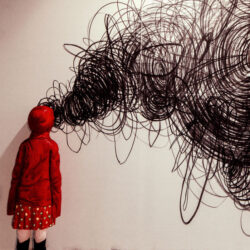

Did she or didn’t she?
He first came to the Station Café about five months ago. The skiing jacket with blue, green and yellow squares over a white background made him stand out against the greys and browns of normal Belgian winter attire. His shoulder length hair was nothing unusual.
He took a table in my section, number 56 by the window and asked for a pintje. I thought I detected a foreign accent. He had a nice smile. He drank it slowly and nibbled his peanuts carefully, taking one at a time from the tiny dish. When both were finished he waved me over and requested the rekening. Again that unfathomable accent. He placed three Euro coins on the table and left the change behind.
Every weekday after that he returned just before the lunchtime rush. Whenever possible, he sat at 56, and always in my section. For the first couple of weeks the staff noticed him. Joran, who dispensed the drinks would wink at me and say, ‘Your Dude is in again.’ I think he got the name from some film.
By the end of October “The Dude” as I thought of him by then, was just another customer, barely noticed except by me. He never stayed very long and always ordered one beer unless it was sunny, then he would have two and leave six euros. Pintje, rekening and Dank U were pretty much all the words he ever said to me in those five months, but his smile got warmer and wider.
Yesterday, he came a little earlier and drank three beers before asking for the bill. He put a ten-euro note on the table and sat looking his empty glass for about ten minutes. As I walked past his table, he stood in front of me and pushed some paper into my hand. He muttered something in English. I think it was, ‘Y’all been real kind,’ and left the café very quickly. I thought I saw tears in his eyes. I certainly welled up when I saw the two fifties.
. . . This morning, no Dude.
When the lunchtime rush got underway, a man arrived wearing a black three-quarter-length leather coat. His hair was cropped to about half a centimetre and he stared directly ahead with a stern expression on his face. For an instant his eyes flickered toward me as he strode past. His eyes.
Nobody noticed he had a gun until two firecracker explosions stunned everybody motionless for a second. During the following pandemonium not one person remembered seeing him leave, but they all remembered the blood soaked walls and the two men slumped over table 13, with gaping holes in the back of their heads.
When I told the police I thought I recognised the shooter, they wanted me to describe him. I said he had shoulder length hair and wore a skiing jacket with blue, green and yellow squares over a white background.
he sat at 56, and always in my section.
He sat always in my section, at 56 if possible.
next, do something about this: as I always thought of him —> something like as I grew to think of him (influenced as you already said in the previous paragraph) in any case avoid always as it appears in the next sentence.
I see, interesting story, I like yer writing style dude~
Hi Nicoletta,
I get the point about always in two sentences. I will sort that.
However my main concern about this is the final two sentences.
I have a slightly different version which potentially changes the meaning. I’d like your opinion on it. This is the other ending:
When I told the police I saw the shooter walk in, they asked for a description. I said he had shoulder length hair and wore a skiing jacket with blue, green and yellow squares over a white background
Funny you called me dude, Nic, When I was working away at a clients I always went to a pub nearby for lunch and the guy serving at the bar told me the staff called me, ‘The Dude’. I didn’t know the term, I hadn’t seen The Big Lebowski then. Thing is, I don’t look like Jeff Bridges as far as I can tell.
When I told the police I thought I recognised the shooter, they wanted me to describe him.
is clumsier than When I told the police I saw the shooter walk in, they asked for a description.
It doesn’t change a lot. You can safely have the ending effect you wanted. This edit, however, makes her LESS likeable.
not that you cannot work more on the ending, the effect is not completely there.
I guess so, I want it open ended.
I agree, thanks.
I just wanted the reader to wonder why she would have said that.
then you need to work on that brief dialogue. you must decide who is going to be more likeable, he or she. And you haven’t decided.
and to answer your question, I think she did
so do I 🙂
when I wrote this I had a particular scenario in mind, but now I’m not so sure. However, I guess that’s what I want from the reader. He/she had to decide for themselves and choose their own options. . . simple as that, really.
I appreciate your input, a big help
she was disappointed she felt used that’s why she turned him in.
‘Y’all been real kind,’ and left the café very quickly. I thought I saw tears in his eyes. I certainly welled up when I saw the two fifties
this is the best moment of your story, did she or didn’t she see real tears? was she punishing herself for being gullible perhaps again and then later although kind-hearted, turned him in? you have a bigger story here. much bigger.
Guaj,
Good build up and ending. Just a couple of observation:
Having grown up in the US I’m used to people calling each other “Dude” and this felt like a forced connection to the film.
Also not too sure why the emphasis on “The eyes.” Is there an implied bond between the two? Can she really have been bought for the “two fifties”?
“with a gaping holes” – drop the a.
I like the second ending, it flows much better and it strengthens the implication of the bond, as she is deliberately activating an image that no longer exists.
HI Bh
I think you have to remember this is set in Belgium. They get a lot of their English from watching US tv series. Also the film is a bit of a cult movie and it could easily be picked up by a film buff. As you can see in my reply to Nic, it happened to me when someone called me The Dude in the UK.
I’ll get rid of the ‘a’ — bad editing I guess.
The whole idea of the eyes, the fifties, the tears and the incorrect description is there for the readers to make up their own mind of what is going on. I have my take but there are more possibilities.
I like the second ending also. I might use it, but the current ending adds even more question IMO.
Like always I really appreciate your comments.
Just a further thought, I realise from the very excellent comments from everybody so far, this could lead to a much longer story if I chose to work on it. Hmmmm.
Sorry, Guaj. In my opinion your story is in need of some serious editing.
The sentence “His shoulder length hair was nothing unusual.” is clumsy as it seems to suggest that it was a common hairstyle.
Your first paragraph could be rephrased thus:
He first came to the Station Café about five months ago; he had shoulder-length hair and the skiing jacket with blue, green and yellow squares over a white background made him stand out against the dull colours of a Belgian winter.
The next thing we have to examine is the waitress’ (we assume it is a female)
motivation in acting how she did vis-a-vis the police after the shooting.
Having recognised the man with cropped hair and wearing a black three-quarter-length leather coat as her regular customer why did she give a different description of what he was wearing?
Did she want him to get off or was she just remembering her first impression of him?
From what we read theirs was the usual client/waiter relationship. No hint of romantic involvement. Did she fancy him or was she influenced by the money? (again we have to assume that the some papers he pushed in her hand were two banknotes of fifty euros). Why should he have tears in his eyes?
A lot of unanswered questions that baffle the reader. There is only a limited amount of imagination that one can resort to. It has the potential of a thrilling story but it has to be developed.
having worked at a supermarket let me tell you how sentimental we become, even males, we really like seeing the same people each day on schedule, we start caring for them and we become somehow something like distant relatives for them too. there is a connection between such personnel and clients. a connection we hate being broken. how else can we survive without this type of connections when our daily jobs are not only physically demanding but quite often unimpressive, tedious, too simple too unimportant for society and others in general.
Guaj didn’t claim that she recognized him because of the haircut or the clothes. Earlier he mentions “the eyes’. He even used a photo of a male focused on his eyes. So yes she has seen him before and she knows that ‘had the haircut and the clothes been different he would be the person with those eyes, sitting usually at 56, always in her section.
You know, Nicoletta I just realised if I expanded on this story the poor little waitress is in for some serious problems with the authorities and ‘others’ perhaps. That interests me.
No need to apologise, Luigi. Surely shoulder length hair is a common hairstyle. I see it every time I go out. I much prefer it to the aggressive fashion of shaved bonces.
First para, I attempted to make it a little colloquial in style, i.e. as she might have expressed herself. Perhaps it could be better.
For the rest, yes it poses a lot of questions doesn’t it? 🙂
AS I said to Bhi and I think Nic, there is tremendous scope for a thriller here, it just never occurred to me until you guys made these excellent comments.
I enjoyed you story, notwithstanding the correct observations made by ifyouplease. More please.
Yes it looks like this has a lot of possibilities. I enjoy writing short stories, but this could be longer. I will think about that, because it will be a lot of work for sure.
Thank you very much for you encouraging comment, they are always welcome 🙂