
Chapter 1
Snatch
Connor
The ties are cheap on purpose.
Garage pack. Blue. The kind a man uses on copper pipe and forgets in a drawer. Two round her wrists, one round her ankle and the chair leg, pulled until the plastic bites and the skin either side of it goes white.
She has not said a word since I came in.
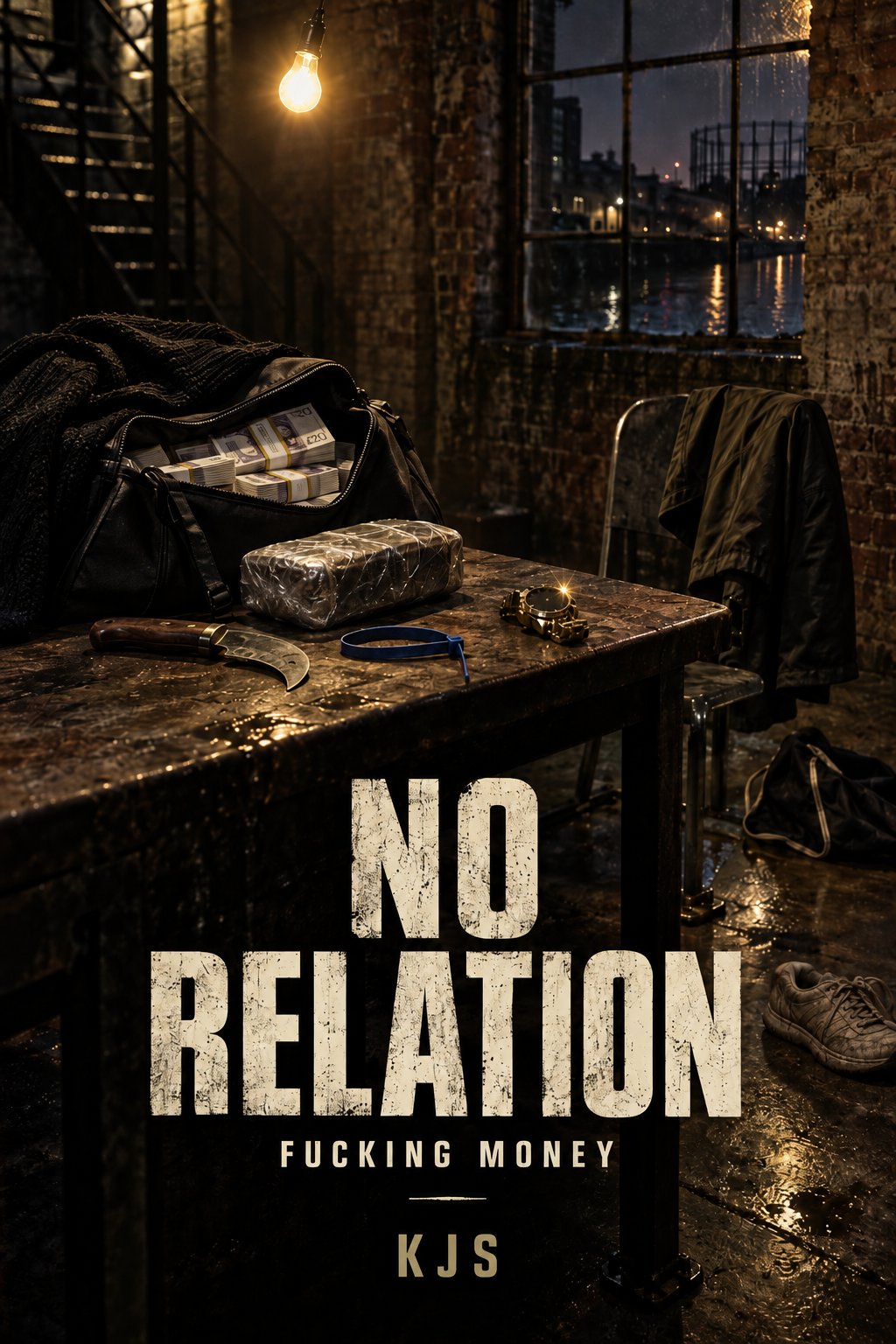
Warehouse off the cut. Brick that sweats. One bulb on a wire that has ideas about dying, swinging a little because I brushed it with my shoulder, so the shadows in here will not keep still. Her shadow on the wall goes long and short, long and short. The river on the other side of the brick makes a noise like someone rinsing blood out of a glass and never quite finishing.
Her head is down. Black jumper. Black jeans. Hair over her face. One trainer has come off and is lying on its side by the chair like it belongs to somebody else.
I put the holdall on the table. I take out the bag. The hook knife. A bottle of water that has been in the van long enough to think it is ice.
She lifts her head at the sound of the knife. Just her eyes, through the hair.
“Who sent you,” I say.
Nothing.
I walk round behind her. The chair is bolted to the floor. I bolted it myself, last month, with a bit from my father’s own box, and I stood here afterwards and pulled on it with my whole weight to be sure. Nothing in this room moves unless I move it.
I put the bag over her head.
It is a cloth bag, the kind you get a new pair of shoes in, and I twist the neck of it in my fist until the fabric goes tight over her mouth. Her breath goes in and pulls the cloth into the shape of her lips. Goes out. Goes in. Faster. Her whole body goes rigid in the chair, her bound hands clawing at nothing, and the chair does not move, because I bolted it.
I count.
Ten. Fifteen. On the other side of the brick the river keeps rinsing. Twenty. Her heels are drumming on the concrete, the bare one and the one with the trainer. Twenty-five.
Thirty seconds is a lifetime if you do it right.
I pull it off.
She drags in air like she has come up from the bottom of the cut. Hair stuck across her face with sweat. Mouth open. Eyes wide and wet and fixed on me.
Then she smiles.
“Again,” she says.
Nia
Forty minutes earlier I was on my knees in the dark in Frank Hale’s lockup with my heart trying to get out through my teeth.
Nobody tells you that. The films show somebody cool. Nobody shows you the body. The way your hands go. The way your bladder suddenly has opinions. The sweat that starts in the backs of your knees. I have done this before, more than once, and my hands still shake so badly I can barely get the key in, and the key came off a hook in Frank’s own kitchen, next to a calendar his dead wife marked up in biro. It is still on March. Frank does not count the years any more.
The till is under a bench behind a tarpaulin. Frank thinks Tuesday is his quiet night. He tells men that at the Hare, in that voice he uses when he wants a room to agree with him. Nobody on the Old Kent Road would dare rob Frank Hale on a Tuesday. Everybody knows that. Frank knows it best of all.
I get the tarpaulin off. Torch in my teeth. Paper, in rubber bands, in a carrier bag from a supermarket that went bust. A brick of something wrapped in cling film that will be a solicitor’s problem by next week. And, in a biscuit tin, for no reason I will ever understand, a gold watch. Heavy. Ugly. Engraved on the back, in curly shop letters: Behave, Big Bear. Home by two. x
I am counting the paper into the holdall when a car pulls up outside.
Engine. Handbrake. The engine stays on.
I turn the torch off.
In the dark my own breathing is so loud I put my hand over my mouth. The shutter is a thin skin of corrugated steel between me and whoever it is. Headlights come through the gap at the bottom of it in a long white bar across the floor and stop an inch from my knee.
A car door. Voices. Two, maybe three. Young. Laughing.
Not Frank’s boys. Frank’s boys do not laugh on a job.
Somebody walks right up to the shutter. I can see the shadows of his trainers in the bar of light. He is so close I can hear him sniff. Then the sound of a zip, and a spatter against the steel, loud as rain on a bin lid, and the others laughing at him, and somebody saying hurry up, man, it’s fucking freezing, and I kneel in the dark with Frank Hale’s money in my lap and my hand over my mouth and understand, in a very clear and quiet way, that if that boy decides to try the shutter for a laugh, and finds it unlocked, and finds me, nobody in either of my worlds will ever know what happened.
Not my father. Not Frank. Nobody.
The zip. Footsteps. Car doors. The engine goes up and the headlights swing away and the bar of light slides off the floor and they are gone.
I sit in the dark until my legs stop. It takes a long time.
Then I finish the count. Forty-two thousand. The brick. The watch.
I put the watch on my own wrist. I do not know why. My hands want something to do.
Connor
Mine was the towpath. Diesel. A camera that goes blind on Tuesdays.
Seventeen minutes. Eden buys them off some bloke at a security firm in Croydon with school fees he can’t cover. I don’t know his name. Don’t want it.
The can’s got a Hale cap. Hale yard, Hale diesel. I put it by the door with the cap loose so it stinks all night. Anyone comes looking, they smell us first.
Then the wrap. Gashi wrap. Her uncle’s print still in the crease. The sort of thing Ilir’s lot leave on a door they want remembered. In the latch it goes.
By morning Hale faces will be shouting Gashi and Gashi faces will be shouting Hale, and nobody will be shouting the two people who actually have a key.
Twelve minutes left. A fox comes along the towpath and stops and looks at me. Then a siren up on the Old Kent Road. Loud. Louder. My legs go. I stand there holding my dad’s diesel waiting for blue lights round the corner of the yard.
They go past. Somebody else’s night.
Fox is still looking. It trots on.
Inside, I wait. She comes in the back with the holdall. Neither of us says a word. She walks past me and sits in the chair and holds her wrists out.
Nia
“Again,” I say, and he does it again.
The dark. The cloth on my mouth. The count. I know what is going to happen and my body does not, and that is the whole reason. For thirty seconds I am nobody’s daughter. For thirty seconds nobody is watching me and I am not watching anyone and there is no family and no feud and no forty-two thousand pounds of Frank Hale’s money in a bag on a table. There is only the dark and the breath and the cloth and his hand.
When he pulls it off the second time I am shaking all over and laughing and I cannot tell which.
He crouches in front of the chair. He cracks the bottle on the edge of the table and pours it slowly down the front of my jumper. It is so cold I stop breathing again. Water down my chest, my stomach, into my lap. My nipples go tight under the wet wool and I laugh at him, mean, like he has told a joke in church.
“Who sent you,” he says.
“Your father. My father. God.” Water is running off my chin. “Pick one you can get hard to.”
He cuts the tie on my left wrist with the hook knife. Leaves the right. One hand free is worse. I use the free hand to find his belt like I am checking a count.
He kisses me with the knife still in his fist. It is not a kiss. It is teeth. It is the siren on the Old Kent Road and the boy pissing on the shutter and the forty minutes I spent in the dark with my hand over my own mouth, and he tastes like it too, like somebody who has been frightened for an hour and has not said so. I have his belt open. He has me up out of the chair with the tie still round my right wrist and my ankle still bolted to the leg until he cuts that too, and the chair is only furniture again.
We do not make it to the mattress at the back. We make it to the table.
The holdall shoved aside and then pulled back, because the money belongs in the picture. Paper against my spine. The brick cold under my shoulder. My jeans at my knees, one boot still on, and he is in me before either of us can make a joke about the money.
I am so wet it is embarrassing. I planned this hour. So did he. The families will log a grab. We log a fuck. Same room. Different books.
“Harder,” I say. “If you are going to pretend this is a beating, beat.”
He does. The table edge in the backs of my thighs. The holdall zip biting my hip. His hand in my hair, pulling my head back until my throat is his, and his mouth on my neck like he is going to leave a name there, and he does not, because names are how Frank finds things.
“Who sent you,” he says, into my throat.
“You,” I say, and it comes out wrecked. “You sent me. Say it.”
He does not say it. He fucks me through the sentence until the sentence dies, and I come with a sound I would never make in front of my father’s drivers, open and ugly and grateful, and he puts his thumb on me after because that is the rule, and I jerk like I have been shocked and try to kick him off the table and do not mean it.
Then something on the stair makes a sound that is not the river.
Connor
We stop dead.
Her free hand on my shoulder. The blue tie still on her other wrist, biting. The holdall open. I am still inside her. That is going to matter in about ten seconds.
Boots on the iron stair. One pair. Coming up slow.
I know the tread before I know anything else. Hale rubber. The cheap sole my father buys in boxes of fifty so that nobody on the firm looks expensive at a door.
One of ours.
Everything goes cold. Slow. Bulb swinging. Water on the floor. Knife on the table, a foot and a half from my hand. Whoever comes through that door sees a Hale with a Gashi girl. There’s one way to be seen in here and live, and this isn’t it.
Bag off the table. Half over her head. Knife in my fist. She goes limp and wide-eyed in a heartbeat, a hostage, worst night of her life, and I’m a Hale with a knife. I don’t pull out. No time. And pulling out would be a picture of something else.
The door opens.
A boy. Twenty, if that. Soft chin. A bat in his hand so new the price sticker is still on the handle. Frank’s idea of checking the cut on a Tuesday: send a kid with wood and a prayer.
“Boss said check the…”
He stops.
He sees the wrap in the latch from the inside. He sees the diesel can by the jamb. He sees her on the table with a bag half over her face and a tie on her wrist and her jeans round her boots, and he sees me, a Hale, his boss’s son, with a knife in my hand and my trousers open, standing between her legs.
I see it land on him. He knows what he’s looking at. Then he knows what looking will cost. Twenty years old. Came up the stairs with a bat because somebody at the Hare told him to.
“You see a Gashi girl in a chair,” I say. My collection voice. Very even. The voice for a door where the debt is about to become a story. “You see Gashi wrap on the latch. You see a bag. What do you think you walked into.”
He swallows. His eyes go to her mouth. To her wrist. The watch. The money on the table.
“A snatch,” he says.
“What do you think you should do.”
“I should not be here.”
“Smarter than my father,” Nia says, from under the bag, and he flinches, because her voice is not the voice of a hostage at all. “Close the door. Face the stairs. If you look again I will tell Ilir Gashi you helped. Ilir does not send boys with new bats. Ilir sends endings.”
He shuts the door.
We listen to him go down three steps and stop.
He is still there. On the stairs, on the other side of the door. Of course he is. I can hear him breathing.
Nia pulls the bag off her own face. She looks up at me. Her eyes are enormous. And then, slowly, with the boy three steps down on the other side of a door, she hooks her heel round the back of my thigh and pulls me further in.
She puts her free hand over her own mouth.
I finish it. God help me. My dad’s boy on the stairs hearing all of it. Table knocking the wall. Paper sliding off. The brick hitting the concrete. Her teeth in the heel of her own hand. She comes again. I follow with my face in her wet shoulder, not a sound, like Frank’s on the other side of the brick.
Then I pull out and fix her jeans for her like I am dressing a wound, and wipe my hand on my own leg, and open the door.
The boy is on the stairs. Red to the ears. Bent over, pretending to tie a lace that does not exist.
“You tell Frank you found Gashi wrap and diesel and an empty chair,” I say. “You tell him I was already gone when you got here. You tell him the till on Tuesday was them. You tell him anything else and I will put you in that chair, and I will not be playing.”
He nods too fast. The bat knocks the rail.
“And the money,” Nia says, behind me.
The boy looks up at her. She is stuffing the holdall. Forty-two thousand, give or take whatever stuck to her skin. A twenty is glued to her stomach in a smear and she peels it off and holds it up between two fingers and looks at him.
“What money,” the boy says.
“Exactly,” Nia says.
He takes the stairs three at a time. We listen to the rubber all the way across the yard. A car that is not ours starts, stalls, starts. Hale maintenance.
Then it is quiet. The river. The bulb. The water on the floor.
I lean on the doorframe. Now it’s over, my hands go. Bad. I put them in my pockets.
“Eden will be angry we spilled the count,” I say.
“Eden can lick it off the table.”
“You do not say that to Eden.”
“I do not say anything to Eden.” She zips the holdall. “You do.”
Nia
He does not know what Eden is. He thinks Eden is a pair of hands at the edge of a wake with a bag and a number. I know Eden is a door that opens both ways. I do not tell him. Not tonight.
I take the lieutenant’s watch off my wrist. Behave, Big Bear. Home by two. Somebody’s wife had that done. Twenty years of standing outside Frank Hale’s toilets and Frank Hale’s doors, and some man is going to wake up tomorrow and find it gone and swear on his children that a Gashi boy lifted it off him in a doorway.
I put it back on.
“I will wear it to the wake,” I say.
“You will not.”
“I will wear it under. You can check.”
He looks at me like I have said something soft. I have. I let it stand.
“Friday,” I say. “The Ivory. Service corridor. Your father will be downstairs talking peace he does not mean.”
“That is upstairs money.”
“That’s what it’s for.”
He kisses me once, clean, which is rarer than the other thing. Mint and smoke and the cut. Then he is a Hale again, phone out, thumb already lying.
I read it over his shoulder because I am not polite.
Gashi on the cut. Wrap on the latch. Diesel in the yard. Chair empty when I got there. Till was them. Sending the boy back. C
Frank will believe it because it is the story he paid for. My father will believe the other half because the diesel can has a Hale cap on it.
I text no one. My father likes silence from his daughter. Silence is another plant.
The twenty I peeled off my stomach I put under the bolt of the chair. Whoever needs a story can have a small one.
Connor goes out the front like a collection that ran late. I wait four minutes. I count them. Then I go out the back, along the cut, past the can of diesel breathing Hale into the dark, to a car a street away that is paid for in cash under a name nobody in either house would know.
At the corner I stop and look back.
The warehouse. The yard. The camera on its pole with its little red light, back on now, watching nothing.
The bulb inside finally dies. The river keeps rinsing.
My hands do not stop shaking until the Rotherhithe Tunnel.
Yes!!!
This is my sort of reading: Active voice throughout. Fast-paced. Quirky. Sparse but effective dialogue. Dynamic PoVs.
My only suggestion would be to consider using contractions, like I’m instead of I am, etc to loosen up the narration.
Great stuff, I’ll be checking the others out.
Steve