
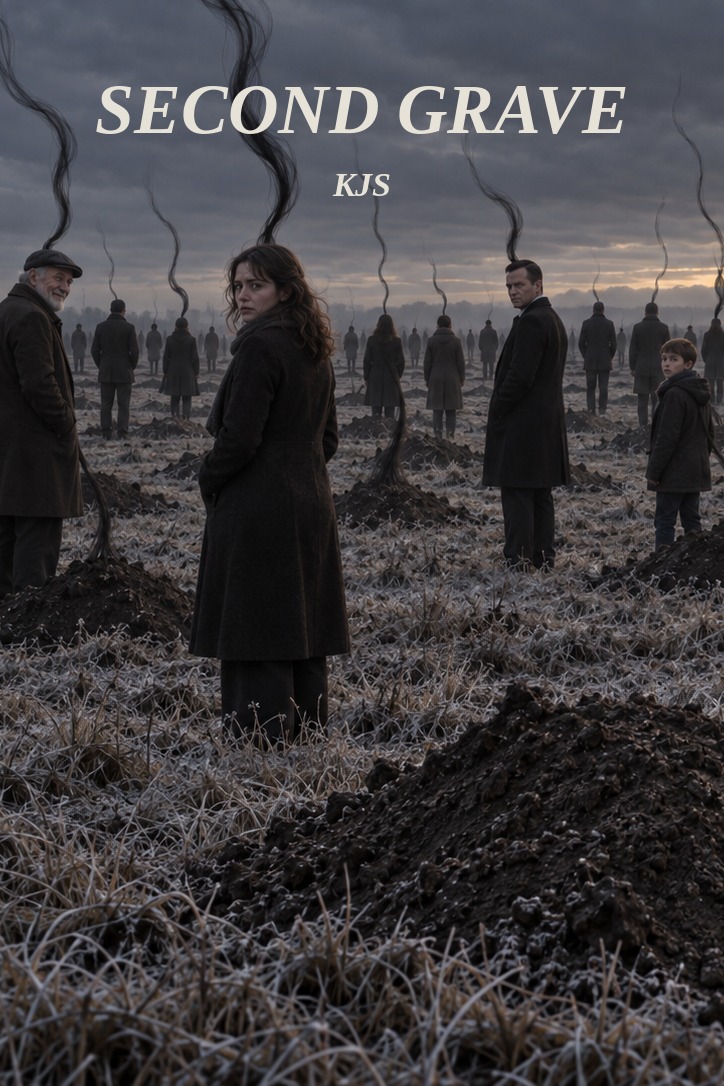
Buried where they lay, or where we laid them.
The ground took the body. The body was the easy part.
The rest went home in someone’s head
and has not left, and will not, while that head is warm.
One killed on orders, in a uniform, at first light.
Never knew the name. Knows the shoe, the turning face.
Buried where he lay.
One killed on orders, in a suit, for money.
Filed it under work. One face would not stay filed.
Buried where he lay.
One killed by accident, one punch, one kerb.
Knew the name. Knew the mother. Went to the funeral.
Plays it nightly, looking for the take where he stands up.
Buried where he lay.
One killed with intent, and keeps it like a coin,
takes it out, turns it to the light, puts it away warm.
Buried where he lay.
One killed with a car and a second’s glance.
Met the family at the inquest. Nothing ends.
Buried where he lay.
One killed and kept nothing. Went home, ate.
Lives three doors down from the mother. Sleeps.
Buried nowhere.
Some of us choose the ground. We choose the stone, the words.
We do not choose the keeping.
Some never had ground. Wolves, dogs, roadside, rain,
whatever takes a body and lays bones.
Some are stacked, skull on skull, Sierra Leone,
a grave with no lid, and the names we knew
would not fix to any skull.
Some say goodbye at the wrong place, never saw the ditch.
Some have seen it. That is worse.
A scar laid down beside the memory.
One lies under marble and a guard.
No one knows what happened. That is why he is a hero.
He is a hero because he died.
He was sent to kill.
Wall upon wall of names, and his has none.
The less we know, the more we lay on him.
The grave he carried, no one gets to read.
Every life ends in one life. Except the told ones.
A told life does not end. It feeds.
Not on blood. On the next mouth.
A mother tells it, a book takes it, a film dresses it,
a child who never saw him says his name
and he stands up again, a little, in that head.
He was never let in. We keep opening the door.
He does not drink. He is drunk from,
generation after generation,
and each drinking is what keeps him.
The only death that lasts a thousand years
needs the living to do the dying for it,
a little each, and never all at once,
and cannot stop, because we do not.
Some are kept on purpose, in marble, a wreath once a year.
Some were meant to be forgotten, the name struck out,
and are spoken more than any name we loved.
Every week the news reaches for one of them
to measure some new man against,
digs him up, dusts him, puts him back a little bigger.
And some are kept. A flag on a bedroom wall,
a boy who thinks it is a colour,
a man who knows it is a name.
A family that took his name.
Adored, in heads by the thousand,
while the good man gets a plaque and a Sunday paragraph.
And one grave nobody marks.
One found the other half and had it,
years of it, the whole of it,
and then it died, and the half that was left
went on, as halves do, badly,
having lost the half that did the carrying.
No wall. No name read by strangers.
One head, and the weight of two in it.
He tries to put it down. Marries. Moves.
Learns the new name, the new side of the bed.
It is not the same. It was never going to be.
The dead do not get lighter with company.
He carries more than any of them,
for nothing done, no order, no blow, no car,
only for having been the lucky one, once.
And most nights a hand goes back to check it is still there,
because the night it is not, she is gone properly.
I read the walls now, knowing my time is coming.
I have stood at first light. I know what I did not see.
Some of these I loathed, some liked, a few I loved,
and I do not know which of those I will be.
I read on because my name will be here
and I would like to know what they will keep.
You have one too. Someone is in there now,
standing up a little, every time you say the name.
We live in the folklore of the dead, and they in ours,
and neither side gets to choose the story.
Not dead. Already kept, and by my own head first,
a weight I carry that is not yet mine to put down,
heavy as one man, or as many.
KJS, September 2026
“Not dead. Already kept, and by my own head first,
a weight I carry that is not yet mine to put down,
heavy as one man, or as many.”
“Heavy is the head that wears the crown” (Shakespeare), whether that be a crown of thorns (memory), or the anonymity of divine forgetfulness. We do indeed “…live in the folklore of the dead, and they in ours,” whether written on the walls or in marble.
A well penned elegy, KJS, one I’m sure your mother would be proud of.
Shywolf
Shywolf, thank you, and for the Shakespeare and the folklore line, both land well here.
A gentle correction though, not the mother but the wife. The widower’s stanza is the one I carried in longest before it found the page. The rest are observed or researched; that one is lived. “Heavy as one man, or as many” is one man’s weight, hers, still carried.
My mother would have read it aloud to me from beyond and told me where the commas were wrong. She’d have been right.
KJS