Out of Pocket
by KJS
from my old prose piece “Lint in My Pocket”
My hand goes in out of habit.
Thirty four years, and it still expects paper.
Netheravon, 1992. A week of falling on purpose.
A bridge over the traffic. A bar I could not find again
if I walked that county for a year.
You at the window. Not symmetrical.
I have lost the colour of your eyes.
I have kept what they did to me.
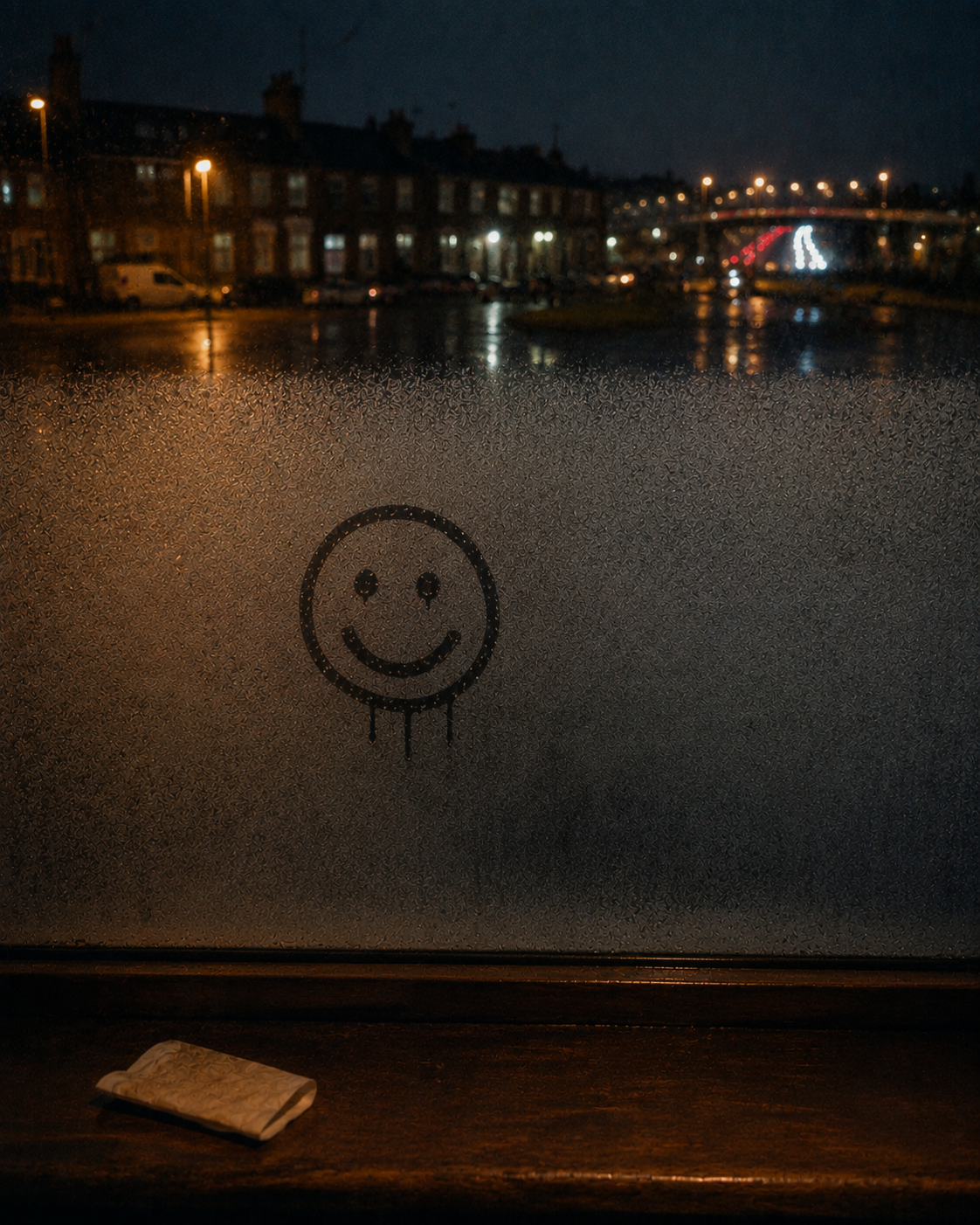
You breathed on the glass and drew a face.
A circle. Two dots. A curve.
A thing built to disappear.
You looked at me through it, and I have never
got out from behind that glass.
Then the paper. Then the door.
Then the sentence.
Maybe we can meet tomorrow.
It left my mouth already false.
I was walking while I said it.
You watched me walk while I said it.
We were not children. No excuse of youth.
Halfway over the bridge I stopped.
The traffic ran both ways beneath us, fast and lit,
the lads ahead of me and loud,
the paper still in my pocket,
nothing lost, nothing lost at all,
and I turned and looked back at the door we had come out of
and grieved for something I was still holding.
Billets. Beer. Morning. The train,
and every mile of it I was certain,
and every mile of it I was going the wrong way.
Arborfield. The jeans. The pocket.
Lint.
I put my hand in again. I put my hand in again.
I offered the same deal to the devil and to God,
first for the paper, then the number,
then only for the name of the town,
and neither of them was buying.
Not a number. Not a name.
Not a town. Not the name of the bar.
Not a tomorrow, folded small.
They say there are two or three in a life.
Maybe one. Maybe none.
Nobody tells you the ticket is paper.
That paper lives in a pocket.
That pockets go in the drum,
and the drum does not care what it is turning.
I did not lose the love of my life.
I lost the one ticket I ever held
that might have been.
I am sorry.
Not for leaving. I had to leave.
Not for losing it, though God knows.
I am sorry that I knew you in the smallest way
a man can know a woman,
and have carried you in the largest.
We had none of it.
Before you, beauty was the even face.
Your smile went further on one side than the other.
There was something at the brow
a sculptor would have sanded out.
The flaw a restorer is told to leave,
because sanded smooth it is only marble,
and left alone it is a person who lived.
In ten minutes you took that belief off me
and left a better one.
Every year since, looking for the part that does not match
and calling it the beautiful part.
That is yours. I never earned it. I kept it.
And what did you get.
A man who asked, took the paper, and never rang.
If that made you slower with the next one,
if someone decent got a guarded version of you
because a soldier said tomorrow while already walking,
then the loss that night was not mine.
I would rather you forgot me than learned from me.
I will never know which.
That is the echo that will not close.
I hope you drew it again.
I hope you drew it for someone who stayed.
I hope he called.
I hope tomorrow came.
I hope you had skin, and the faint salt of it,
and breath at the neck,
and mornings with a stupid grin
because there was nowhere either of you had to be.
I hope your pockets held keys and coins and old receipts,
and I hope that once, on a wet afternoon,
your fingers found lint
and you were angry with me for a second,
and then were not.
You are still twenty five.
The glass is still misted.
The little face is still there,
and I am still reaching into that pocket,
believing the paper must be somewhere inside.
I named you so I could keep you, Sophia.
I would have called.
That is the most useless true sentence of my life.
My hand goes in again. Soft grey. Nothing.