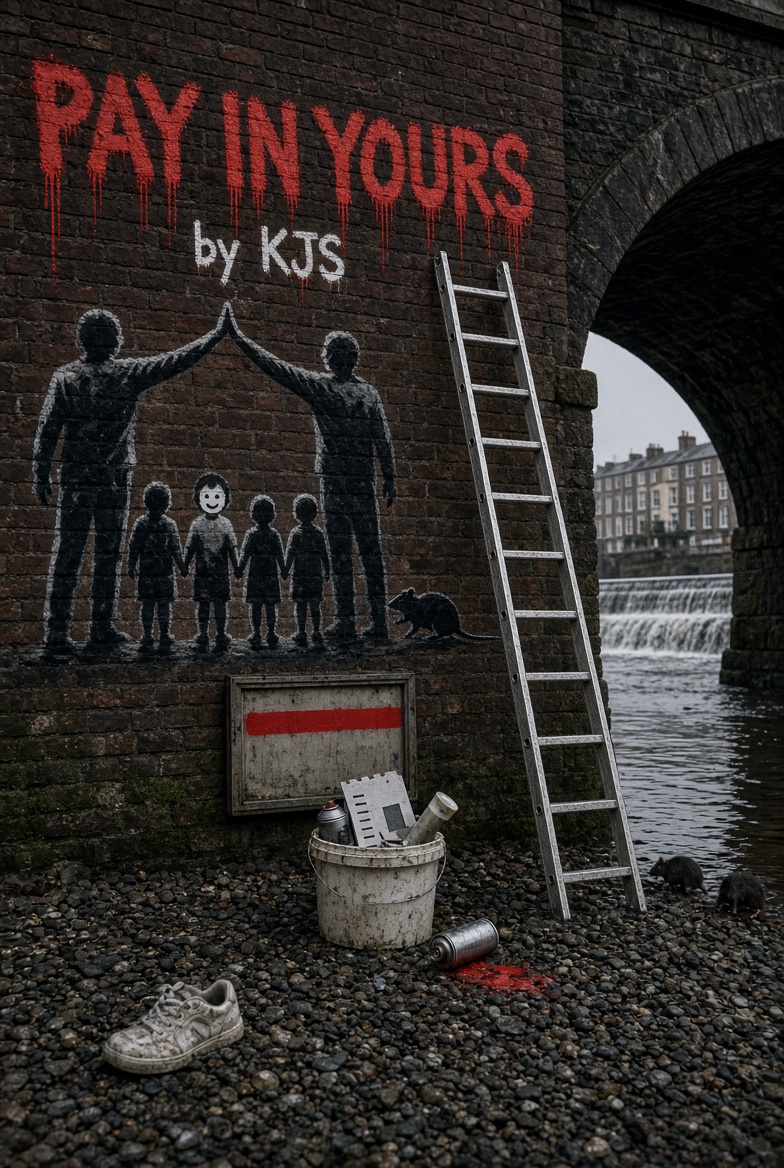
PAY IN YOURS
KJS
CHAPTER ONE
When will you pay me? say the bells of Old Bailey.
The Assembly Rooms have a slap-back off the north wall that nobody has ever fixed, and I have spent thirty years mixing around it the way you drive around a pothole you have stopped noticing.
Ninety milliseconds. I could tell you that in my sleep. I have told people that at parties, when I still went to parties.
The room was built in 1611 and rebuilt four times and heritage-listed in a year I could look up, and every one of those rebuilds left the north wall exactly where it was. There is a plaque about it in the foyer. There is a plaque about everything in the foyer.
You asked for it in the order it happened, so it starts with a wall.
#
Doors at six. Scan at the doors.
I do not run the scanner. I run sound. But you can hear the scanner from the desk, a soft chirp per entry, and after enough years you count without meaning to. Four hundred and eleven that night. I remember because it was a Tuesday and Tuesdays are usually three hundred and change.
Free show. All ages. Sponsored, the poster said, by Get Home Safe, and there was a logo, and under the logo a line about how every child in Hamlin deserves a place to be a child.
I have never had a problem with that line. I have gone back through everything I ever thought in this building and that line is one of the things I still cannot make myself hate.
#
Kier came out for line check at twenty past five, plugged in, played four bars of nothing, and stood there with his hand flat on the strings looking at the ceiling.
“You alright?”
He did the thing he does, which is answer a different question. “How many out there.”
“Doors aren’t open.”
“Right.”
He is fifty-one and has been in that band longer than I have been at that desk, and every year for a decade he has told me he is quitting, and every year the contract comes round and he signs it and does not appear to understand why. I used to find it funny. I stopped finding it funny somewhere around the third time he said it in the same voice.
He played four more bars and went back through the curtain.
I brought the house music up. Whatever was on the civic feed that month, which was that song, the one everybody had. Four hundred people came through those doors over the next hour and I would guess three hundred and eighty of them mouthed along to it without being aware they were doing it.
I could not tell you how it goes. I want that on the record, because it turned out to matter more than anything else I ever failed to hear.
My left ear has been gone since I was fourteen. Not gone-gone. There is something in there. It takes in noise and turns it into pressure, the way a wall does. What it does not do is tell me anything.
So I hear music the way you would see a face through one eye at the wrong angle. I know what it is. I cannot tell you which one it is. Anything with a strong centre image, anything mixed to sit in the middle, comes to me flattened and sideways and generic, and I have built an entire career out of the parts of a mix that live at the edges, because those are the only parts I get for free.
People think that is a tragedy. It is why I am good.
#
Dusk at 7:14 that night. The overlay pushes the chime.
You do not notice it. That is the entire design. Seven notes, low in the mix of the world, over every screen and every civic surface and the little speaker in every terrace doorway. It has been there since the network went up, and before the network it was the school bell, and before that the carillon at St Anne’s, and before that I have no idea and neither does anyone.
It means go home. It means you are safe now, whoever you are, wherever you got to today. It is on the tote bags they sell in the foyer.
Four hundred and eleven through that door and every one of them born into that sound.
I felt it more than heard it. Ninety milliseconds off the north wall, a soft double, the way it always was.
Then RatRace came out and I brought the faders up and I did my job.
#
Pyde does not look at the desk. In thirty years he has never once looked at the desk.
I have been told this is a common thing with singers and I have worked with maybe two hundred bands in that room and it is not a common thing. They all look. They want more monitor, they want less, they want to know why the low end went away in the second song. Pyde stands in the light with one hand at his side and sings into four hundred people, and the four hundred go very quiet, quieter than a room that size should be able to get, and then very loud.
By the fourth song that room is at thirty degrees and the windows on the north side are running with it, and there is a smell it gets that is deodorant and wet coats and the dust off the old boards, and I have breathed it since I was twenty-two.
The mix that night was easy. It is always easy. I have never once had to work in that room during a RatRace show, and I stopped asking myself why about twenty years ago, around the same time I stopped noticing the north wall.
Ninety-four minutes. No encore. There has never been an encore.
#
Load-out is the part I like.
The room empties in about eleven minutes when it is a school night and about twenty when it is not, and then it is just the flight cases and the boys from the hire company and the hum of the house lights coming up to full, which is a hum at exactly fifty hertz and which I can hear perfectly, because fifty hertz sits at the edge of everything.
I was coiling a mic line when I saw her at the top of the raked seating on the north side. Sitting down. Coat still on.
Fourteen, maybe. Hard to say from the floor. She had her chin on her knees.
I said something. I do not remember what. Something like we’re closing, love, or do you need a lift. The sort of thing you say a hundred times a year in this job to kids waiting for a parent who is late.
She said, “I’m alright.”
Not upset. Not frightened. Waiting, the way you wait for a bus you know is coming.
The boys from the hire company took the risers out. When I looked back up she was gone, and I did not think about it, because kids go. That is the whole nature of them. You look up and the seat is empty and they are in the foyer or the car park or already three streets away with their hood up.
The doors were open. The lights were on. It was twenty to eleven at night in the safest city in the region, and she walked out of my room, and I did not follow her out and I did not ask her name and I did not think about her again for eleven days.
#
The lights went at twenty to eleven.
Not a flicker. All of it, in one go, the way a building goes when a breaker trips, and a room that size with no windows is a completeness of dark that people who have not stood in one do not believe.
Somebody laughed. Somebody always laughs. One of the hire company boys said a word and then said sorry to nobody.
Eleven seconds. I counted, because counting is what I do with my hands when there is nothing in them.
Then they came back, all at once and at full, which is worse than coming up, and the room was exactly as it had been. Cases where the cases were. Risers stacked. My coil of mic line on the boards with the loop I had made.
Nothing had moved. That is what I want you to have.
And then something went across the floor about twelve feet in front of me and into the dark under the raked seating.
I did not see it. I saw its shadow, thrown up the north wall by the worklight on the stand behind it, and the shadow was the size of a dog. Bigger. It came up that wall in about a second and a half and it was coming at me, and I got my arm up.
I got my arm up, in an empty room, in front of a wall.
Then it was gone under the seating and the wall was a wall and I was standing there with a coil of cable in one hand and the other one over my face.
“Damn rats,” said the hire company boy, from somewhere near the doors, and went back to what he was doing.
#
I know why it was that size. I want to be clear that I knew within about four seconds, because it is not complicated and it is not even interesting.
A worklight on a stand is a point source at about knee height. Anything that passes close to a point source throws a shadow that scales with the ratio of the distances, and if the thing is a foot from the lamp and the wall is thirty feet behind it, the shadow is thirty times the animal.
That is inverse square, near enough. I have known that since I was nineteen. I could have drawn it for you on the back of a desk sheet at the exact moment my arm was over my face.
It did not help.
That is the thing about knowing. It arrives afterwards, and it arrives complete, and it does not go back and unmake the second and a half.
I have thought about that a great deal since, because it turns out to be the only lesson in this entire account, and I got it for nothing on the eleventh of a Tuesday in a room I had worked in for thirty years, off a rat and a lamp.
#
There was a van at the loading bay when I brought the last case out.
White, green stripe down the side, back doors open, a man in coveralls loading a long grey box with a hose fitting on one end. He nodded at me the way people who work nights nod at other people who work nights.
I nodded back and put the case in the car and went home.
I have gone over that night maybe four hundred times since, and the thing I keep arriving at is not the girl, and it is not Pyde, and it is not the chime.
It is that I did not read the side of the van.
It was six feet from me. It was lit. I have described that loading bay to two separate inquiries and I described the van both times, white with a green stripe, and both times the person taking it down wrote that and did not ask, because there was a van like it outside their own house that week.
They were outside everybody’s house that year. That was the year of the rats.
#
Bill was in the foyer when I came back through for my jacket, talking to the duty manager with his coat over his arm.
He had done the pre-show welcome, the way he always did. Ninety seconds, no notes, and he got a laugh out of four hundred teenagers, which if you have ever tried it is not a small thing.
“Merrick.” He always got it right. Never Vance, never mate. “That was loud.”
“That’s the idea.”
“My daughter’s going to want to come to the next one, and I’m going to say yes, and then I’m going to be the man at the back with the earplugs.”
“I can put you on the desk. You’d hate it.”
“I’d love it.” He shifted the coat. “Left or right?”
Nobody asks that. In thirty years I could count on one hand the people who have asked me that, and most of them were doctors.
“Left,” I said.
“Right, so I’ll stand on your left and you won’t have to hear me.”
He was already going. He got to the door and turned round with his hand on it, and this is the part people find hardest afterwards, so I will put it down plainly.
He said, “Get home safe.”
And he grinned, because it was the name of his own programme and he knew exactly how it sounded, and it was funny, and I laughed.
I was still laughing when the door shut.
#
The lights had gone at twenty to eleven and come back at eleven minutes to.
I put that in the desk sheet the next morning, in the NOTES box, in my own hand, because that is what the NOTES box is for.
Total supply loss 22:40, restored 22:51. Not the rig. Checked, nothing wrong at desk.
I did not write down that a girl had been sitting at the top of the raked seating at twenty to eleven and was not there at eleven minutes to.
There was no box for that.
PAY IN YOURS
KJS
CHAPTER TWO
Ashes, ashes, we all fall down.
The Folletts kept the good chair for him, which was the worst part.
Six years of Thursdays and Marla Follett still moved the ironing off the armchair before he sat down, still put the pot on, still had the tin out of the cupboard before he had his coat off. There was a routine to it now. The routine was the problem. Routines are what people build when they have stopped expecting an outcome and started needing a shape.
Dobs sat. The chair was too soft and it put his knees above his hips and there was no way to be in it that did not look like a man who had given up.
“You look terrible,” Marla said.
“I’ve had a week.”
“You’ve had six years.”
She was not being cruel. She poured. He watched his own hand go out for the mug and made a note of the way it went, which was not steady, and put that in the same drawer he put everything.
Ewan Follett had been thirteen. He would be nineteen now. There was a photograph on the sill that Marla had never updated to one of the age-progressed ones the charity did, because she had looked at the age-progressed one exactly once and then put it in a drawer face down, and Dobs had been in the room when she did it and had not said anything, and it was one of about four decisions in his life he was still sure about.
The photograph is him in a school jumper with the collar wrong, taken by a photographer who did four hundred of them that morning. Everything else Dobs knows about the boy he knows from a woman at a kitchen table. That he could not sit still. That he ate cereal at any hour. That he had a thing that summer about learning to whistle and could not do it, and went round the house for six weeks making a noise like a kettle not quite on.
“I’ve got some of it,” she said, and went to the biscuit tin, which was not for biscuits.
“Marla.”
“Don’t.”
“I’m not going to say anything.”
“You always say something.”
He took it. Two hundred and forty in twenties, which he did not count in front of her, and a foil tray off the top of the fridge that was still warm on the bottom, and it was a lasagne, and it was Thursday, and this was what he was paid.
He had been a police officer for twenty-two years and had done this for nine, and people assume there is a licence for it and there is not, not in this country, whatever they have seen on television. Anybody can put a card in a launderette window. That is the whole qualification. He has never once corrected a client about it and has never once been asked.
In between there had been a period of about fourteen months that people were kind enough not to bring up.
#
Her sister Deb was there that week, which he had not planned for. Deb had opinions.
The radio was on over the sink. Local, the mid-morning one, adverts and a phone-in and then that song, the one that was on everything that summer, and Deb went ooh and moved her shoulders at the sink without turning round.
Dobs stood up, crossed the kitchen, and turned it off.
There was a silence of the specific kind you get in another person’s house.
“Right,” Deb said.
“Sorry.”
“Are you though.”
“No.” He sat back down.
Marla did not look up from the table. She had seen him do it before. She had seen him do it at the hospital and at the memorial and once in a car with the ignition on and the radio coming up automatically, and he had pulled over to turn it off, and she had never asked.
Nobody ever asked. That was the thing about a man like him. There was so much wrong on the surface that people did not go looking underneath it. They filed the radio thing under the drinking, and the drinking under the coat, and the coat under the whole shabby fact of him, and never checked whether the pile added up.
It did not add up. He could not have told them why. He had never once in his life been able to sit in a room with music in it, not at his own wedding, not at his father’s funeral, and he had spent five decades assuming that was a fault.
#
“They’re saying it’s the rats,” Deb said, drying her hands. “For the smell up the top end.”
“Probably.”
“They’ve been three times in this street. Three. My cousin’s over in the Reach and she says they’ve had them a year over there and nobody sent anybody, and now it’s this side and suddenly there’s vans.”
“There’s vans,” Dobs agreed.
“It’s all come from over there, is what they’re saying.”
Marla said, quietly, “Deb.”
“I’m not saying anything.”
“You’re saying something.”
Dobs let it go past him. He had heard that sentence in nine hundred kitchens and it always arrived in the passive voice. It is all coming from over there. Nobody ever named who was saying it.
“And she won’t go over it now,” Deb said, apropos of nothing, still on the vans and the rats and the other side. “Our Yvonne. Won’t drive over the Verrall.”
“Since when?”
“Since she came over it in the March and had to pull in at the top. She said she went all funny. Dizzy, and a pain across here.” Deb put a hand flat on her own chest. “Thought she was having something. Kevin says don’t be silly, it’s the roadworks, and she says I know what the roadworks feel like, and now she goes round by the Tolworth and it puts eleven minutes on her.”
Marla said, “Her mother was the same about the Verrall.”
“Her mother was the same about everything.”
“She was, but she was the same about that.”
Dobs wrote nothing down, because there was nothing to write. He has since read that exchange back off a tape in his own head about four hundred times.
Deb sat down. She had got onto the children by the time the pot was cold, the way people did, because that is what he was in the house for and everyone knew it.
“My mother used to say,” Deb said, “that Ring Around the Rosie was about the plague. The rosie’s the rash. The posies is what they carried for the smell. Ashes, ashes, and down you go. Isn’t that a thing. Kiddies skipping about to the Black Death.”
“That’s not true, though,” Marla said.
“It is.”
“It isn’t. Ewan came home with that. Year six project. It’s Victorian. They banned dancing so the kids made up ring games instead, and somebody made the plague thing up hundreds of years after, and now everybody says it.”
“Well, everybody says it,” Deb said, “so.”
And that was the end of it. Marla went back to the table and Deb put the pot in the sink and the correct answer sat in the middle of that room for about four seconds and then nobody picked it up.
Dobs wrote ring in his book, and did not know why, and underlined it, and did not know why he did that either.
#
He worked the way he always worked, which people found difficult.
He did not ask her about the day. He never asked about the day. Everyone asked about the day. Six years of officers and journalists and two separate charities and a podcast, and every one of them had opened with what happened on the day, and Marla Follett had given the same eleven minutes of narration so many times that it had worn smooth and stopped containing anything.
He asked about the gaps.
“When you called out for him,” he said. “First time. Not the police. Just out the back door, calling.”
“I’ve told you this.”
“Tell me it again but different. What were you doing before you called.”
She thought. She was good at this now. She had learned his questions the way you learn a bad knee.
“Putting the shopping away,” she said. “I’d done the freezer stuff and I was doing the tins.”
“How long do the tins take you.”
“Four minutes. Five.”
He took the watch off his wrist and put it on the table face up, which is what he does instead of writing, and tapped the glass twice with a fingernail.
“Four to five,” he said, to the watch.
He did not say it to her. He said it down at the dial, and tipped his head slightly, and waited, and then nodded once as though something had come back.
Deb, at the sink, made a face at nothing.
Marla did not. Marla had watched him do that in a room at the station in front of two detectives who had exchanged a look, and then watched him tell those same detectives, off that same dial, that the search had begun ninety minutes later than the log said.
Which it had. Which had never been explained.
“Nineteen days,” Dobs said.
“What?”
“Between Ewan and the next one.” He turned the watch a quarter turn on the tabletop, like a man lining up cutlery. “Eleven days between the one before Ewan and Ewan. Nineteen after. Twenty-three before that. Then it goes eleven, nine, nineteen, twelve.”
“That’s just numbers.”
“Yes.”
“They’re not the same.”
“No,” he said. “They’re never the same. That’s what I keep getting stuck on. If it were the same number I’d have had it years ago and so would somebody better than me.”
“Then what good is it.”
“None yet.”
“Then why say it.”
He picked the watch up and put it back on and pulled his sleeve down over it.
“Because it isn’t random,” he said, “and I haven’t got anything better to give you, and I’m not going to sit in your house for six years and give you nothing.”
Marla put both hands flat on the table.
“Have you found him,” she said.
“No.”
“Are you going to.”
“No.”
Deb turned round from the sink very fast. Marla put a hand up without looking, and Deb stopped.
“Right,” Marla said. “Thank you.”
She saw him to the door herself. She always did.
#
The watch was four minutes fast. It had been four minutes fast a long time and he had never had it seen to. The man in the arcade had offered twice, for nothing, as a favour, and Dobs had said no both times without explaining, and the man had stopped offering.
He stood on the Folletts’ step and looked at it, and it said 11:19, and it was 11:15.
There was a van at the top of the street. White, green stripe, back doors open, two men and a stack of black bait boxes on the pavement, and a woman from number 40 standing over them with her arms folded, telling them something at length.
Dobs looked at it for about as long as you look at a van.
Then he put the lasagne on the passenger seat and drove back across the river with the radio off, and it was still warm against his hand at the lights, and he had to put his hand back on the wheel and leave it there, because it was a Thursday and he had told a woman he was never going to find her son and she had thanked him and given him her cooking.