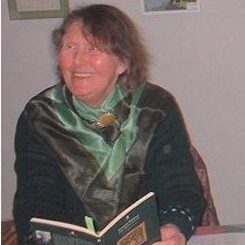
Hedd Wyn (Ellis Evans) WAS KILLED AT THE END OF wORLD wAR oNE.
WAR
Woe to me that I live in so gloomy an age,
where God ebbs to the horizon,
replaced as commoner and king by man
who raises his hideous dominion.
Sensing that God has departed
he has raised a sword against his brother,
the noise of battle fills our ears
and above poor cottages its shadow hovers.
The harps that once were played now hang
from the willow’s twigs; the wind’s refrain
is filled with the cries of boys
and their blood mingles with the rain.
(My translation of Hedd Wyn’s poem ‘War) see below for Welsh original.
rhyfel
Gwae fi fy myw mewn oes mor ddreng,
A Duw ar drai ar orwel pell;
O’ i ol mae dyn, yn deyrn a gwreng,
Yn codi ei awdurdod hell.
Pan deimlodd fyned ymaith Dduw
Cyfododd gledd i ladd ei frawd;
Mae swn yr ymladd ar ein clyw,
A’i gysgod ar fythynnod tlawd.
Mae’r hen delynau genid gynt
Ynghrog ar gangau’r helyg draw,
A gwaedd y bechgyn lond y gwynt,
A’u gwaed yn gymysg efo’r glaw.
The poem is inseparable from the context of World War One, in which Hedd Wyn (Ellis Evans) himself was killed. This war’s unprecedented brutality shapes every line of the poem, even though it never names the conflict directly.
1. The loss of faith and moral orderThe opening lament—“Woe to me that I live in so gloomy an age, / where God ebbs to the horizon”—reflects the spiritual crisis provoked by mechanised warfare. Millions witnessed horrors that seemed to contradict any belief in divine justice. This disillusionment was a hallmark of First World War literature.
2. Brother killing brotherThe line “he has raised a sword against his brother” evokes the trench warfare in which ordinary men—often neighbours, workers, farmers—were forced to slaughter one another. The fratricidal tone mirrors the senselessness of a war fought between nations with intertwined histories.
3. The destruction of rural and cultural lifeWyn’s imagery of “poor cottages” overshadowed by battle, and “harps…hung from the willow’s twigs,” reflects how war silenced Welsh cultural life. Rural communities lost huge numbers of young men, and traditional music, language, and local identities suffered.
4. The deaths of young soldiersThe final image—“their blood mingles with the rain”—directly echoes the muddy, rain-soaked killing fields of Flanders. It is both symbolic and literal: young Welsh boys died in landscapes indistinguishable from this description.
The war does not merely influence the poem—it is born from it, emotionally, morally, and artistically. It is both a condemnation of humanity’s fall into violence and a lament for a culture and generation annihilated by the conflict. Wyn’s own death renders the poem a tragic prophecy fulfilled.
I feel so elated reading such poems today. This is a lucky Sunday for me, as it is beautifully sad as well.
Thankyou Supratik for your careful reading and comment. Do you understand any Welsh? Some years back when I was frustrated by the knowledge that HW’s poems were no longer in print I decided I should publish them myself. A good friend in the village with whom i used to read stories to improve my welsh, had two copies and gave me one, bless sher. So I sat with the computer and dictionary for 3 years and copied out the whole of HW’s boook. I actually sold another copy last week. Nice to know it’s still around.May have to get some more printed. Hope they have not lost my account. Also time I got around to translting another of his poems — a short one. Those for the eisteddfod are much too long and too classical for me.
again thank you for careful consideration.