
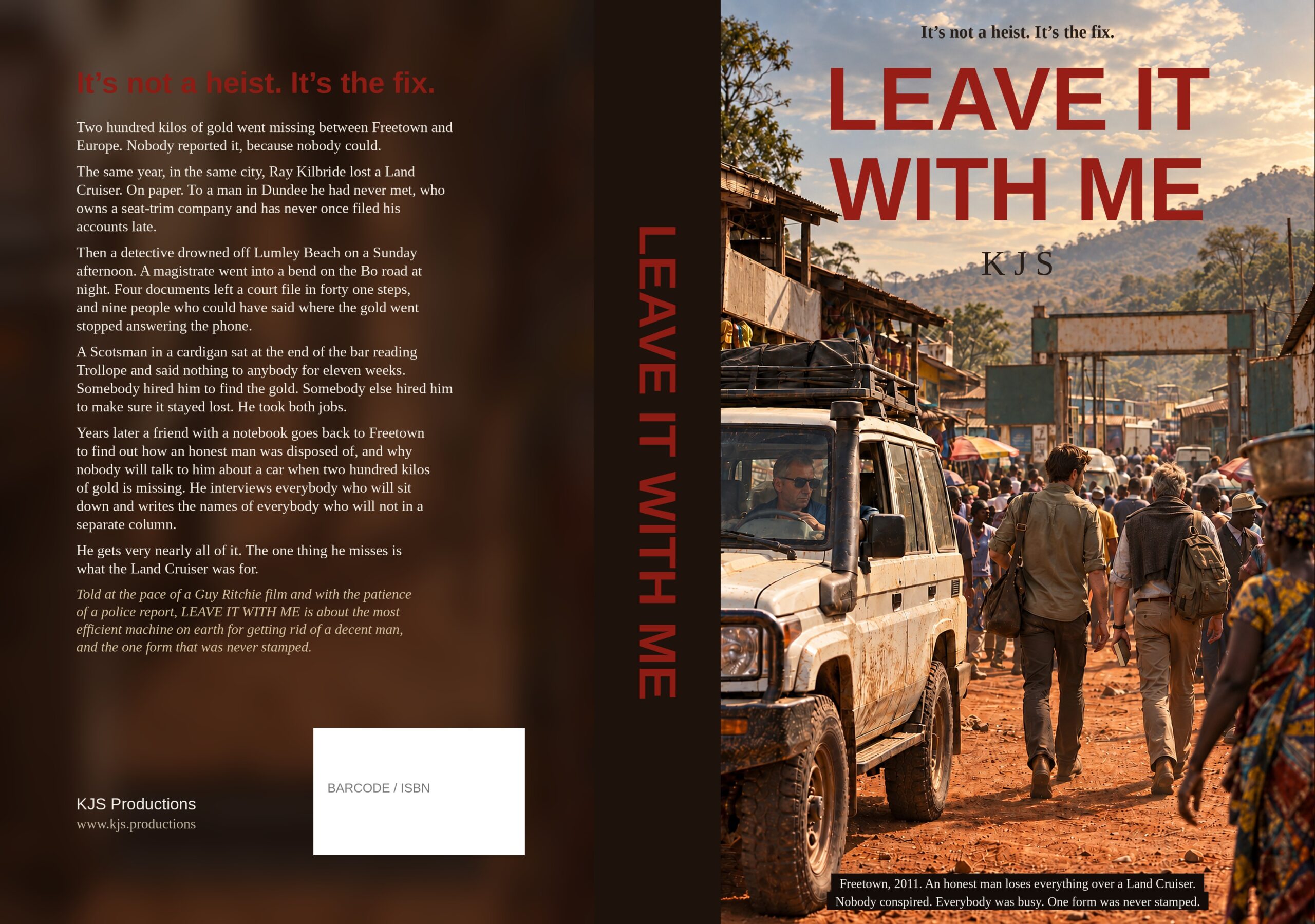
LEAVE IT WITH ME
a novel
KJS
SAMPLE FOR SUBMISSION
The opening (chapters 1 to 4) and two consecutive chapters from the middle (28 and 29).
Full manuscript: 72 chapters, 104,800 words. Literary crime.
A British security contractor in post-war Sierra Leone loses everything over a Land Cruiser, and the man who destroyed him is a seat-trim company in Dundee that has never filed its accounts late.
It’s not a heist. It’s the fix.
1
A WEDNESDAY, ROUGHLY
The first thing they took out of the Land Cruiser was the radio.
Not the vehicle. The radio. A boy of about nineteen in a police shirt two sizes too big for him leaned in through the passenger door, put one knee on the seat, and started working the head unit out of the dash with a flat screwdriver, and he did it carefully, the way you do when somebody has told you the thing is worth money and will be coming out of your pay if it breaks.
From about a dozen feet away, which was as close as the other three would let him stand, Ray Kilbride watched him do it.
“That’s a Codan,” Ray said.
The boy kept working.
“It’s an HF set. It’s not a stereo. There’s nothing on it you want.”
Slipping off the corner of the fascia, the screwdriver skidded, and the boy sucked his teeth and started again from the other side.
Behind them the compound gate stood open, which it never did, and beyond the gate the road down to the wharf was doing what it did every morning at ten past eight, which was carry four hundred people and nine hundred kilos of fish uphill in a smell you could lean on. Nobody looked over. In that part of town, a white man standing very still next to four policemen was not an event. It was a Wednesday.
I was not there. I have had this morning described to me by four people, and three of them agree about the radio.
There was a piece of paper in the sergeant’s hand. He had been holding it since he arrived and had not once looked at it, which told Ray everything, because a man with a real order reads it to you. A man with a photocopy holds it like a ticket.
“This vehicle is going to CID,” the sergeant said. “For investigation.”
“Investigation of what?”
“Of the vehicle.”
Ray nodded slowly, as though this were reasonable, because he had learned in a different country a long time ago that the moment you tell a man in a uniform that he is being stupid, he has to become something worse than stupid in order to get out of the room with his face on.
“Can I see the order.”
“You can see it at CID.”
“Then I’ll follow you to CID.”
“You will not follow us anywhere.”
With a sound like a tooth, the radio came free. Backing out of the cab, the boy held it against his chest with both arms and both hands, and the coax whipped out behind it and caught on the seat runner and he tugged at it twice and then just pulled, and the aerial lead came out of the roof mount and the rubber grommet came with it, and now there was a hole in the roof of Ray’s vehicle the size of a two pence piece, and out of everything that happened that year, that hole was the thing Ray thought about at four in the morning for the next fourteen months.
Not the poison. Not the hospital in Croydon. The grommet.
Into the driver’s seat went the second policeman. Both hands on the wheel, mirror adjusted to a face that was not Ray’s, and then he started the engine, and the engine did what it always did, which was catch on the second turn with a rattle from the tensioner Ray had been meaning to sort out since March, and he thought, absurdly, don’t ride the clutch, the clutch is going.
“It’s going to CID,” the sergeant said again.
“Right.”
“For investigation.”
“You said.”
Round in a tight arc across the yard, out through the gate, and left.
Left was not the way to CID.
While it turned, the sergeant watched Ray’s face. That part was for him. The vehicle was for somebody else.
“Mr Kilbride,” the sergeant said, and now he did look at the piece of paper, briefly, as a courtesy, the way you glance at a menu you already know. “You should go inside.”
“It’s my yard.”
“Yes.”
He stood in it for a long time after they had gone. Then he went in and made a list on the back of an invoice, because he had been trained by an army that no longer existed to do something rather than nothing, and the list said:
- Life card
- Receipt of purchase
- Photograph the roof
- Ring Alex
He got as far as three.
- · ·
On Wilkinson Road eight days later, with a different plate on it and a fat man in the back and a bottle of orange Fanta sweating in the cupholder, he saw it again. It still had the hole in the roof.
Shot at twice in a country that changed its name while he was serving it, and out of a burning column outside Umtali at nineteen carrying a man who died two miles later, Ray Kilbride understood at that moment that he was in real trouble.
Not because they had taken the vehicle.
Because they had not bothered to fix the roof.
- · ·
- · ·
Borbor Bele — Emmerson
- · ·
2
TWO PEOPLE, ONE OF WHOM IS ALREADY DEAD
Before we go on, you should know who this is about.
RAY KILBRIDE. Fifty one. Born Bulawayo, buried nobody there. Enlisted at seventeen into an army that lasted another two years and then stopped, along with the country, on a Tuesday in April, which he still refers to as “the day they cancelled us.” Has been paid to stand near other people’s property in nine countries since. Runs Ashgrove Minerals (SL) Limited, which does not mine anything and never has, and which holds a licence from the Office of National Security to put unarmed men in white shirts outside gates. Vice: he cannot let a thing go. Rule: never eat what you did not watch being cooked. Says “right” when he means no.
EMMANUEL CONTEH. Twenty six. Detective constable, CID, Freetown. Will sign his name to a three month investigation that concludes, on paper, in Ray’s favour, and will then watch four documents leave his file between his desk and the prosecutor’s office on the second floor, a journey of forty one steps. Vice: he wants to be good at this. Rule: he does not have one yet, which is the problem.
He has eleven days.
- · ·
Weapon Conflict — Sierra Leone’s Refugee All Stars
3
THE FOLDER
I was not there. That was said a page ago and it will be said again, because it is the only credential on offer.
Before the plantain, before the funeral, before the boxes, you are owed a short account of who is telling you this and what he was paid.
- · ·
The folder came in the post in the spring of 2016.
A Jiffy bag, second class, with a compliments slip from a demolition company in Burnham on Sea that had been dissolved for over a year. On the back of the slip, in capitals, with a biro that was running out:
YOU WRITE. DO SOMETHING WITH THIS OR BIN IT. R.
Inside were court documents, a police report with a stamp on it that I could not read, photocopies of photocopies, eleven letters to eleven offices with the replies clipped behind the ones that had replies, a receipt for a Land Cruiser, and a photograph of a hole in a roof the size of a two pence piece.
Ray Kilbride and I met on a job in a country neither of us goes back to, and we have kept in touch the way men of that trade keep in touch, which is a phone call about twice a decade and a card that arrives in February. He had told me about the vehicle once, in three sentences, in 2012, and I had said that sounds terrible and moved the conversation on, and he had let me.
- · ·
I read it in an evening and rang him the next morning and said no.
That belongs on the record early, since the rest of this book puts other people’s refusals on it.
It was his story, I said, and he should write it. He said he had read it enough. A book like this needs somebody who was in the room, I said, and he said everybody who was in the room was either dead, promoted, or in Dundee, and that the only man who kept turning up to rooms after the fact was the one holding the phone.
Thinking about it was offered. He said, “Right.” I have since learned what that word means when he uses it.
Into a drawer went the folder. Two years it stayed there, thought about most weeks and left alone, and you will notice, by the end, that doing nothing for two years while thinking about it most weeks is the exact shape of every failure in this book, and that I was practising it in an English kitchen while writing about other people doing it in Freetown.
- · ·
Here is what changed, and it is money, so I will be quick.
In 2018 a publisher who had taken two small books off me asked what was next, and out came the folder, and she said yes before I had finished the second sentence. There was an advance. It was modest and it paid for nine days in a country I had never been to, a good deal of train travel, a hotel in Dundee, a return to The Hague, and about four years of telephone calls.
You are told that now because a man who turns up at your table with a notebook has been paid by somebody, and every person who talked to me was entitled to know by whom, and so are you.
- · ·
THE MAN WITH THE NOTEBOOK. Fifty eight when this began. English. Has written for a living, at the quieter end of the trade, since a career that stopped early for reasons that are his and are dull. Was two hours from Ray Kilbride by car for the whole of the worst year and sent six emails. Has the documents. Has interviewed everybody who would sit down and has written down, in a separate column, the names of everybody who would not. Vice: he has got good at talking to widows. Rule: say what you cannot prove, every time, in the sentence where it matters.
- · ·
What this is, and what it is not, so that you are not waiting for the wrong thing.
This is not an investigation. There will be no arrest at the end of it and I have not been looking for one. I know where the vehicle is. I know who has it, and I could drive you to his gate. The question this book asks is a different one and it is the one that kept me at kitchen tables for four years: how was it possible, and could anybody have stopped it, and what was every single person in it doing at the moment they did not.
The answer to the second question is yes. The answer to the third is the book. The answer to the first turned out to include me, and I will get to that.
The method, in four lines, and then it is Ray’s book again.
Where there is a document you get the document. Where there is a witness you get who, and where they were sitting, and what they had to get back for. A name I cannot prove becomes a description and the word cannot. I count things, because the paperwork counts things, and because when I stop counting I start guessing.
From time to time there will be a break for what somebody said to me in a car park, or a kitchen, or on a bench outside a garden centre. The furniture will be in it because the furniture is how you tell I was there.
Properly, you will hear from me once more, at the very end, and by then you will be in a position to judge whether I earned it.
- · ·
Paper Planes — M.I.A.
4
FRIED PLANTAIN
Full draft. This goes between the caption chapter and the funeral, and it is the reason the funeral works.
- · ·
Sunday was the day they both pretended.
He was CID and CID does not have weekends. She was a trader and traders do not either. Somewhere around 2006 the two of them had arrived, without discussing it, at an arrangement in which Sunday was a day off for both of them, which was a lie both ways and which they maintained for five years.
He came at two.
- · ·
THE HOUSE
Two rooms and a back, on a lane off the main road, with a tin roof and the gap under it, and a yard at the back with a mango tree in it that was not as good as the one up the hill and which the family were loyal to anyway.
The table was outside the front. The table was the shop and the shop was the house.
Soap, matches, sachets of water, phone credit. Maggi cubes from the second year. Bread on the days she could get it warm, which was Tuesdays and sometimes Fridays and was the best margin she had.
FATMATA CONTEH. Fifty one then. Taught for nine years before the war and traded for nineteen after it, and if you asked her what she did she said she was a trader, and if you asked her twice she said she had been a teacher.
Four children. Two daughters, both married, one in Kenema and one four streets away. Emmanuel. And Ibrahim, the youngest, who went to Guinea in 2008 and rings at Christmas and at Ramadan and is doing, he says, fine.
Her husband died in 1999 and she does not discuss it and the family has left it where she put it.
- · ·
THE PLANTAIN
She did fried plantain on a Sunday.
Not because it was special. Because he had liked it at six and had gone on liking it at twenty six and had said one thing about it in twenty years, which was “is there more.”
Ripe, nearly black, cut on the diagonal, in oil that was too hot for the first few pieces and then exactly right, in a pan she had bought in 1997 and which is still in that house.
Sometimes rice. Sometimes fish. Always the plantain, and she made too much, every single week, on purpose, for twenty years.
- · ·
WHAT HE WAS LIKE
He ate at three.
He was hopeless with money, in the specific way of a man who is generous rather than a man who is stupid. He lent forty thousand leones to a cousin in the March and let it go the same afternoon and would have lent it again in April.
He was terrible at football and played anyway, in the road, and was funny about how bad he was. That is a much rarer gift than being good.
He lost his shoes. Constantly. One of a pair, never both, and he lost them in the house, and at twenty six the family were still finding a single shoe behind a door and holding it up at him without saying anything.
He wrote in books. Not a diary. Marginal notes, in whatever he was reading, mostly arguing with it.
And he chewed his biros. All of them, flat, at the end, so that every pen in that house was his and everybody knew it and left it unsaid.
- · ·
THE CHAIR
He fell asleep at four.
In the chair by the door, with his shoes off and his feet up on a crate, with his mouth open, for an hour and a half, and the entire street walked past him.
Nobody in that house ever woke Emmanuel on a Sunday.
It was a rule and it was the kind that is stronger for having been said by no one. His sister did not wake him. His mother did not wake him. Customers came to the table an arm’s length from his head and were served in an undertone, and some of them looked over and smiled, because everybody on that lane knew what he did and everybody on that lane had a view about the police, and the view did not extend to him.
His mother told me about that and it is the only time in two hours that she smiled properly.
She said: “He worked in the night. In the night, when you work, nobody is happy to see you. So on Sunday, in my house, he sleeps.”
- · ·
THE LAST ONE
There was nothing about it. That is what she needed me to understand and she said it three separate times, in three different ways, over two hours.
He came at two.
He ate. He had three pieces and then two more and said “is there more” and there was.
He argued with his sister about a footballer for ten minutes with his mouth full and lost the argument and knew he had lost it and went on anyway.
He said he was busy at work. He said it the way you say it, as a complaint about hours, the way a man says it when he does not want to be asked a second question, and his mother did not ask a second question, and has spent fourteen years wondering.
He fell asleep in the chair by the door with his feet on the crate and she let him and he slept for an hour and forty minutes.
When he woke up he said, “Why did you let me sleep,” which he said every single week.
He asked if there was more plantain and there was not, because it was six o’clock.
At the door he said he would come Thursday.
He never came Thursday. He had never once come on a Thursday in his life. It was a thing they said, and she said “all right,” which is what she said, and that was the last thing either of them said to the other.
Then he went off up the lane with one hand raised, not turning round, the way he always left.
- · ·
THE ELEVEN DAYS
On the Wednesday of the second week he rang her and said he was fine and that work was work and that he would see her Sunday.
On the Friday he came past the table at about seven in the morning, for the first time in his life, and stood there for a while with his hands empty and did not come in.
She has taken that Friday apart, morning by morning, ever since.
He talked about the rain. He asked whether Ibrahim had rung. He said his sister’s boy was getting tall.
And then he said, “If anybody comes here asking about me, you don’t know anything.”
And she said, “About what?”
And Emmanuel Conteh, twenty six, detective constable, who had eleven days and did not know it, said:
“Nothing. I’m being stupid. Forget it.”
Then he laughed, and went to work.
- · ·
WHAT STAYED IN THE HOUSE
A jacket he had not worn since December, on a hook, with an envelope in the inside pocket that nobody had any reason to look in for another eleven days.
And a biro, chewed flat at the end, on the table by the chair.
She did not move it for four years.
When she finally did, she did not throw it away. It is in a tin in that house with three photographs and his police identity card and a school report from 1997, and I have seen all of it, and she took it out and put it back one item at a time and did not hand me any of it.
- · ·
Corruption E Do So — Daddy Saj
28
THE DOOR BEHIND ME
It was not their camp and it was not their contract and they had no business being in that building at nine o’clock at night.
Billy had suggested it in the afternoon because the site was a client the company had been courting for a year and because Jock had said, in the office, that an upcountry mining camp was a thing he had yet to see and would like to.
That is the whole reason. A man said he would like to see something.
- · ·
WHAT WAS ACTUALLY WRONG WITH THAT CAMP
Six men from a security company in the accommodation block, doing a handover assessment. Not a response team. Assessors, with clipboards, in polo shirts, who had driven up that day and were leaving in the morning.
And on the camp itself:
- Twelve local guards on shift, employed by the site rather than the company.
- A guard commander who held the keys to the store.
- A store, a steel container with a padlock and a hasp, containing the shotguns that the licence permits and the ammunition, which is required by law to be in a separate locked box inside it.
- And a radio net that reached a forward base a good hour and a half away by road in daylight, which it was not.
- · ·
WHAT HAPPENED AT ABOUT HALF EIGHT
The men came out of the village and up the access road and there were around forty of them, nobody counted and nobody could have, and they had sticks and cutlasses and stones, and they were shouting, and they were not a militia and I am not going to let the word stand.
They were workers.
Three weeks unpaid on a site where the pay run had failed twice before, following a dispute with the operator that had been escalated in writing, twice, and to which the response had been that the matter was being processed.
You have read that sentence about nine times in this book. This is what it looks like on the twenty first day.
- · ·
The twelve local guards left.
All of them, inside about five minutes, and I am not going to write a word against them and neither will you when you have thought about it for a second. They lived in that village. Half the men coming up that road were related to half the men on that gate. They had no weapons, because the weapons were in a container, and they were not going to stand in front of their own cousins for eight hundred thousand leones a month on behalf of a company that had not paid anybody.
And the guard commander went with them, with the keys, in his pocket.
Not out of cowardice, necessarily. He was twenty minutes down the road before anybody noticed, and the keys were an afterthought, and a man who is running does not stop to think about a hasp.
- · ·
SO: SEVEN MEN IN A BUILDING
Six assessors and a Scotsman in a cardigan who had come to look at a camp.
They went to the safe room, as you do, and the safe room was what a safe room is on a site like that: a room at the end of an upstairs corridor with a steel door and a bolt and a window with bars on it.
The corridor is twelve metres long and about a metre wide and it has no other exit.
They were on the radio and they were on two phones and the answer from the forward base was three quarters of an hour at absolute best, and it was dark, and that road at night is not a road.
Downstairs, they started burning things. The generator house first, then the vehicles.
- · ·
THE TEN MINUTES
Jock kept quiet for ten minutes.
He sat on a plastic chair at the end of the room with his back to the wall and let six professional men, all of them competent, all of them frightened, run all the way through every option they had, out loud, at volume, twice.
Which is the same thing he does in a meeting and which Billy had watched him do in an office three weeks earlier and had not understood at the time.
Then the room went quiet, the way rooms do.
And Jock said: “Right. I have an idea.”
- · ·
“We’re not staying in here.”
“We’re absolutely staying in here.”
“You are staying in here,” said Jock. “I am not.”
He stood up and took off his jacket and then his shirt, and rolled two lengths of steel bar and a heavy torch and something else unidentified afterwards by anybody into the shirt, and twisted it, and put his jacket back on over the top.
Somebody said the obvious thing, which was that there were forty of them.
And Jock said the sentence that is the actual content of this chapter, and he said it in that flat unplaceable voice, buttoning his cuffs:
“This corridor is a killing bottle. There is one door and it is steel and it will hold for about ten minutes and after that we are seven men in a metre-wide passage with no room to move and nowhere to go, and every one of us dies in the order we are standing in.
“Out there I have three hundred and sixty degrees and I can run.”
Somebody said that even so, forty men.
“I am not going to beat forty men,” said Jock. “I have no intention of trying. I am going to make them uncertain, and then I am going to make the uncertainty expensive, and then they are going to want to go home and discuss it.”
He was doing his cuffs.
“Ask yourself what they actually know. There are two vehicles on that pad. Who is in this building? They do not know. How many? They do not know. Armed? They do not know, and they cannot know, because we were not expected and we are not on any list and nobody told them we were coming, because nobody told anybody we were coming.”
He looked up.
“That is the only asset in this building and it is worth more than the shotguns in that container. And it lasts exactly as long as nobody goes out there and shows them what we are.”
“So don’t go out there.”
“If I stay in here they find out in ten minutes when the door goes. If I go out now, they find out nothing, and they have to guess, and people guess high in the dark.”
Then: “Lock the door behind me.”
- · ·
WHAT HAPPENED NEXT, SEEN FROM A WINDOW WITH BARS ON IT
I have this from three of the six and from Billy and they do not entirely agree and I am going to give you the parts they agree on.
He did not creep out. He came out of that door at a walk and then at a run, straight into the light of the burning generator house, shouting, and the thing everybody remembers is that he was shouting before anybody had seen him.
What he was shouting, the first thing, in a voice none of the six had heard him use and an accent none of them had heard him have, was:
“Come on, yer bastards.”
And then, without a pause, that there were men behind him, and they were angrier than he was, and they had firearms and he did not, and he had come out first because he wanted to and they were coming out next because they had been told to.
There were no men behind him. There was one man of fifty six in a jacket with a shirt full of scrap iron, and three words that had been waiting thirty years to be said in the right place.
- · ·
The crowd did the thing crowds do. The front of it stopped and the back of it did not, and for about three seconds the whole street was guessing.
Somebody threw a stone.
And he went straight at the man who threw it.
That is the part all five accounts agree on and it is the part that ended it, because a crowd of forty can deal with a man who backs away and cannot deal with one who selects an individual out of it and closes.
He put that man down and he put two others down and one of the five accounts says five and I have gone with three.
Nobody was killed. Two men were hospitalised, one with a broken forearm and one with a fractured jaw, and they were treated at the clinic in the district town and I have confirmed that independently and I am glad to be able to write it.
- · ·
The crowd did not run. It is important to say that, because a film would have them run.
It backed off. Slowly, over about a minute, still shouting, still forty strong, into the dark at the edge of the light.
And then it did the thing he had been waiting for.
It stopped being one crowd.
Twenty or so went back down the access road together. A dozen went sideways into the trees, and that is not a retreat, it is a group deciding to have a conversation somewhere the light does not reach. Six or seven stayed at the edge for a while longer and then went in twos.
That is the whole of it and it is not dramatic and it was the entire object of the exercise.
A crowd of forty is one thing. Four groups of ten, in the dark, with two men hurt and nobody in charge, is four conversations, and every one of those conversations starts with somebody asking what is actually in that building.
It stayed stopped. It was always going to stay stopped, because the thing that makes a crowd move is the confidence of the man next to you, and the man next to you was now a hundred metres away behind a tree with a different opinion.
And Jock walked back to the door, at a walk, and knocked, and said: “It’s me.”
- · ·
UPSTAIRS
They let him in and one of the six, who was thirty one and from Durban, said:
“We watched you. You’re a fucking madman. You could have died out there.”
And Jock, putting his shirt back on, said:
“If I were not a fucking madman we would all be dead in that corridor, son. I could not do it from in here. Out there I had somewhere to go.”
And then, and Billy has repeated this to me twice and laughed both times:
“That is the difference between my generation and yours. You are all extremely well trained and you have never once had to decide anything.”
Then he sat down on the plastic chair and picked up his book.
- · ·
WHAT HE WAS ACTUALLY DOING, WHICH IS NOT WHAT IT LOOKED LIKE
He was not fighting. Six men watched a man fight forty and that is not what they watched.
He was buying forty five minutes, and he did not know whether it was forty five, which is the part that should frighten you.
The radio calls had gone. The forward base had acknowledged. A response team was coming and would arrive when it arrived, on a road that was not a road, in the dark, and no man in that building had a number.
So the problem was never how do we beat them. It was how does this building stay shut for an unknown period, and there were only three ways.
- Hold the door. Ten minutes, then the corridor, then seven men in a line.
- Wait and hope. The same thing, with less control over when.
- Take the uncertainty they already had and make it cost something.
He took the third one, and it worked, and the reason it worked is that he did damage.
That is not a pleasant sentence and I am not going to soften it. A free bluff is tested inside a minute. Three men on the ground means the next man forward has to weigh it, and while he is weighing it he is not moving, and while nobody is moving the clock runs.
The injuries were the point. Not a regrettable side effect of the plan. The plan.
- · ·
AND THE RISK, STATED PROPERLY
He might have died. Easily, and in several ordinary ways, and he knew it on the way out of the door.
A stone to the head from behind. A man with a cutlass who did not back off. Somebody with something under a shirt. A trip on the broken ground by the generator house. That is the one that actually frightens the professionals, because a man on the floor in front of a crowd is finished and everybody in that trade has seen the photographs.
He had no armour, no radio, no light, no sidearm and no plan for getting back in beyond knocking on a door and hoping six frightened men opened it.
He calculated, correctly, that he had a better chance in the open than in the corridor, and he was right, and being right about that is not the same as it having been safe.
- · ·
AND NOW THE PART THAT IS THE BOOK
The response team arrived at twenty past ten.
The operator’s country manager flew up the following afternoon and was appalled, and said so, and used the words unacceptable and duty of care, and looked for somebody to give an interview to, and found the camp empty.
And the pay dispute was settled inside a fortnight.
Three weeks of wages, in full, plus an ex gratia payment, agreed by an operator who had not answered a letter in three weeks and who answered a fire in a fortnight.
So the men who came up that road got what they were owed, and they got it because they came up that road, and they would not have got it otherwise, and every single person involved knows that and none of them will ever say it.
- · ·
Jock knows it. He said so, to me, in Scotland, on a bench, without being asked.
“They were right,” he said.
I asked whether that had occurred to him at the time.
“It occurred to me in the corridor,” he said. “I had ten minutes.”
“And?”
And Jock, who is seventy now, with a dog and a cottage and a sign over the door, said:
“And there were six men upstairs who had done nothing to anybody, and a locked box, and a corridor with one door in it.”
He watched the valley for a bit.
“Being right is a separate question from what is about to happen. I have never once been able to get the two of them to be the same thing, and I have stopped trying, and that is the whole of what I learned in thirty years.”
- · ·
Ghetto Struggle — Kao Denero ft. Busy Signal
29
MAD JOCK
The six of them came down from upcountry on the Wednesday and were in that bar by half seven on the Thursday, as men do.
They had told it to each other in the vehicle, twice. That is where it began. They told it to the two men who met them. That is where it set. And by the Thursday night they were telling it to a table of strangers who had bought them drinks, and by then it had a shape, and the shape was a good deal bigger than the thing.
- · ·
HOW IT GREW, IN ORDER, OVER ABOUT NINETY MINUTES
Version one, at about eight, from the South African, who had been at the window:
“He went out on his own and he put three of them down and they backed off.”
That is accurate. That is what happened and it is what I have written and he said it in nineteen words.
Version two, half an hour later, from a different one of the six, to a bigger audience:
“He went out into a crowd of forty and started swinging.”
Version three, at about half nine, with the table now twice the size:
“He was like an animal. I have seen nothing like it in my life. He split them. He went through the middle of them and split the group in two.”
Version four, which I heard myself, secondhand, from somebody who was not there, in a different bar, a fortnight later:
“They had machetes. He took one off a bloke.”
- · ·
Not one of them was lying. That is the thing to hold onto and it is the reason this chapter is in the book.
All six were doing the honest thing, which is telling you what it felt like from behind a barred window at night with a generator house on fire forty metres away and a man you had known for a week out in the middle of it.
It felt like an animal. It felt like a crowd being split. So that is what got said, and the next man said it back with the adjective moved slightly, and by the eleventh telling there were machetes in it.
I have spent this entire book explaining how the truth gets lost between a thing happening and a thing being recorded, and I have mostly explained it with filing cabinets, and here it is in ninety minutes in a bar with everybody behaving perfectly decently.
- · ·
MAD JOCK
The name arrived somewhere around version three and it arrived from the youngest of the six, who was twenty six, and it stuck inside a fortnight across that entire town.
Mad Jock.
And then somebody at the table said he must be the son of Mad Jock.
“Who?”
“Mad Jock. The Scotsman. Second World War. Went into Normandy with a sword.”
There was a general noise of recognition, because everybody has heard it, and somebody said the thing about the bagpipes, and somebody else said the thing about the longbow, and it was agreed at that table, with total confidence, that this Jock must be a descendant of that Jock, the mad Scotsman with the claymore.
“No,” said Tam Docherty, to his glass. “He’s English.”
“He’s what?”
“English. And it’s Jack. Mad Jack. Not Jock. An officer. First name John.”
The table did not accept this.
“He had pipes.”
“Aye. And he was from Surrey. Sandhurst.” Tam did not look up. “Got a bollocking there for walking onto a parade with an umbrella up. That’s your man. Bow, sword, pipes, and an umbrella on the parade ground, and every one of you thinks he’s a Scot because of the sword.”
“So he’s English.”
“He’s English. The story’s English. Only the sword’s Scottish, and he bought it.”
There was a pause while the table lost a hero and got him back as a different nationality, which a table can do in about four seconds, and then Gareth said, “Well, that’s worse,” and the table agreed that it was worse, and moved on to the umbrella, which was a better story than the sword and which nobody had heard.
- · ·
I mention it because Jock came in at about ten and heard the end of it, and knew, and had known since he was a boy, and said nothing.
He has read more than anybody in this book. He would have known that man was from Surrey before the sentence finished.
He let a table of drunk men be confidently wrong about a thing he knew, in a bar, about himself, and picked up his drink.
That is either the most disciplined thing in this manuscript or the funniest and I have never decided.
- · ·
WHAT HE SAID WHEN THEY PUT IT TO HIM
They put it to him, obviously. Loudly, all at once, with the youngest of the six doing the swinging arms.
And Jock, in that flat unplaceable voice, with his book still under his arm, said:
“No. No, there was none of that.”
“Mate, we watched you.”
“You watched me make a noise.” He sat down. “I was playing for time. There was no other option and the response was an hour out for the better part of an hour and I was the oldest person in that room, so it fell to me.”
“You went at them.”
“I made them uncertain. They did not know who was in that building or how many of us there were or what we had, and I needed them to keep not knowing, so I went out and pretended to be a bit mental.” He shrugged. “It worked. It was extremely lucky that it worked. If it had not worked we would all have been buggered.”
Then he said: “It was not anything special.”
And he opened his book.
- · ·
AND THAT MADE IT WORSE
Of course it did.
*A man who says it was nothing to a room that has already decided he is an animal has not corrected the story. He has confirmed it and added modesty to it.*
The South African said, afterwards, to me, in 2019, still entirely sincere:
“That’s what they say, isn’t it. That’s exactly what that sort says.”
I asked him whether he had considered that it might simply be true.
And he thought about it for a moment, and said: “No.”
- · ·
AND THE PART THAT COST SOMETHING
There was a second conversation going on at that table and it started late in the evening and it is the reason this chapter matters more than it looks.
Who is he, though.
He’s not on anybody’s team. He was just up there having a look.
A bloke doesn’t do that. Not a consultant. Consultants get behind the door with everybody else.
He’s here for something.
By the end of that week, a man whose entire professional value was that you could not describe him ten seconds after looking at him had a name, a reputation, a nickname and a rumour attached to him in every bar on that coast.
He had been invisible in that company for a month. He needed eleven weeks.
- · ·
Billy Okonkwo-Hart was at the bar, not at the table, and watched the whole of it happen, and has told me that he understood the cost of it late that night and could see no way to stop it that did not make it worse.
He said: “If I’d walked over and shut it down, that would have told the whole bar there was something to shut down.”
So he stood at the bar and let it run.
And the following Monday, in the operations office, three men who had ignored Jock for a fortnight said good morning to him.
- · ·
WHAT JOCK SAID ABOUT IT, YEARS LATER, ON A BENCH
I asked him whether the bar had wrecked it.
“It shortened it,” he said.
“By how much?”
“I do not know. Weeks.”
Then he watched the valley for a while and said the thing that I think is the last word on the whole of it.
“A man who has done something and says it was nothing is not believed. A man who has done nothing and says it was something is believed immediately. I have yet to work out what to do about that and I have stopped minding.”
- · ·
Somebody in that bar, that night, said the phrase that followed him for the rest of his time in that country, and it was said with total admiration and it is on the record and I am going to print it exactly as it was said.
“He’s a crazy cunt, that one. Now I know why he never talks about himself.”
He had, in fact, talked about himself. He had explained precisely what he had done and precisely why, in about sixty words, an hour earlier, to that man’s face.
- · ·
AND THEN HE DID THE OTHER THING, WHICH WAS THE CLEVER ONE
He had a problem and he had identified it before anybody else in that room, which was that being interesting in that town was the most expensive thing that had ever happened to him.
So he fixed it. In about six minutes. In front of everybody.
- · ·
They were on their feet when he came over. Somebody banged a chair. The youngest of the six started the applause and the rest of the table went with it and it carried to the bar, and for about ten seconds a beach bar in Freetown was clapping a man in a cardigan.
And Jock stood there and let it happen, and did the face.
Slight embarrassment. Eyes down. A small dismissive motion with one hand. Somebody said speech and he shook his head and looked at his shoes.
He is a good deal better at that than he ought to be, and the evidence is that at the exact moment he was doing it he caught Billy Okonkwo-Hart’s eye across the room and winked.
Billy told me about the wink in a kitchen in Hampshire and laughed for a long time.
- · ·
Then Jock said, to nobody in particular, in the voice of a man mildly inconvenienced by a delivery:
“I could murder a pint.”
Which got a bigger laugh than anything else said in that building that year.
He worked his shoulder round in its socket, winced, and said:
“Buggered my back, mind. And this shoulder. I am getting far too old for a game of rugby.”
- · ·
Rugby.
That is the whole move and it took him three words.
He had taken the thing they had watched and filed it under a Saturday morning injury, and once a room has laughed at a joke like that it cannot go back to being awed, because it has already chosen the other thing and rooms do not go backwards.
Then he sat down in the chair he always sat in, the one at the end with its back to the wall and a view of both doors, and he opened his book.
- · ·
The pint arrived in under a minute and he said “ah, that’s me” and somebody at the bar shouted that it was on him, and somebody else shouted over the top of that.
He did not buy a drink in that bar for the rest of the week and made a very poor job of pretending he minded.
- · ·
AND TWENTY MINUTES LATER
They had forgotten him.
Entirely. Two tables of men deep in it, loud, delighted, every one of them with a version, and the subject was not Jock.
It was Mad Jack, and the umbrella.
- · ·
Because that is what a room does with a story it likes. It finds the bigger one and goes there, and Jock knew that, which is why he let a table of drunk men be confidently wrong an hour earlier and said one word against it.
He did not correct them because the wrong man was the better story and the better story was somewhere else.
- · ·
WHAT THEY HAD, AND WHAT THEY GOT WRONG
Every element of that story those men had at that table was accurate, the longbow and the broadsword and the pipes and the walk across the Alps and the umbrella, and I have checked all five. They got one thing wrong for twenty minutes, which was his nationality, and it was the only detail any of them actually cared about, because it was the one that connected him to the man sitting nine feet away reading Trollope, and a Glaswegian who says about nine things a night spent one of them taking it away from them.
- · ·
Jock did not look up once.
The South African went over at about midnight, having had a thought, and asked him whether he had ever done the bagpipes, or, failing that, an umbrella.
And Jock said: “I play the clarinet. Badly. And not since 1979.”
Which is true, and which I have confirmed, and which killed the conversation stone dead, and which is the last thing anybody in that bar got out of him that night.
- · ·
WHAT IT BOUGHT HIM
Not everything. The name stuck and the rumour ran and the three men in the operations office still said good morning on the Monday, and he still lost weeks he could not afford.
But the men in that bar went home talking about a dead Englishman with a sword, and by the Saturday the story in that town was about the sword and not about the camp.
He gave them a better legend than himself and they took it, gratefully, and it is the most sophisticated thing anybody does in this book, and he did it in six minutes with a joke about rugby and a wink.
- · ·
I asked him about it on the bench, years later. I asked whether he had steered it.
He thought about it for a long time, as he does.
“They were going there anyway,” he said.
Then, after a while, looking at the valley rather than at me:
“I may have helped them along.”
- · ·
Grap N Clap — Pupa Banja