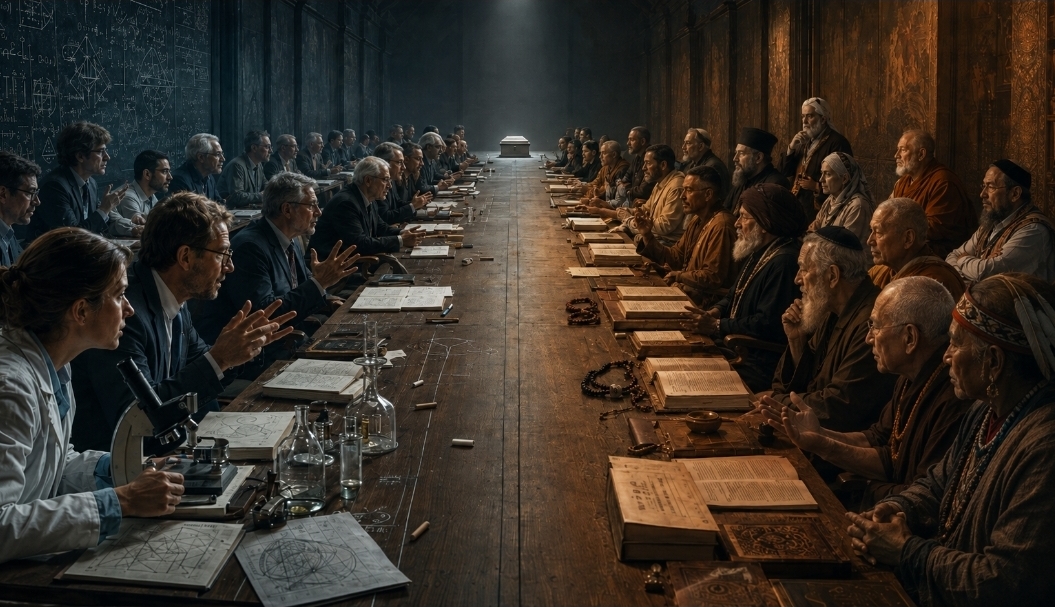
Written in 2021 as four lines turning on a single word, and rewritten in 2026 after the death of my wife. The original asked whether free will exists and answered nothing. The rewrite knows who was asking and why. Each line ends on a different sense of "will": volition, divine decree, testament, consent, and the flat auxiliary that closes it. Science and faith sit either side of a long table and argue over a coffin neither of them is looking at, and each hands the bereaved a cure.
Hi, I’ve read this a few times and enjoyed the ‘will’ repetitions, emphasis, play. It works really well, I think. Your intro illuminates the poem. I’m sorry for your loss.
I was a bit perplexed by ‘each still handed me a cure.’ But this doesn’t detract from the overall success of the poem. Best wishes, Kim
AUTHORThank you Kat, and for reading it more than once, love that.
Writing has been my therapy, but not the cure.
That is what the line is carrying. Both sides of that table had an answer ready for me, offered as though grief were a condition to be treated. Whether “cure” holds that on the page or only in my head is exactly what I was unsure of, so your note is the answer to that.
Kevin
A poignant and lasting tribute to your grief over a loss that confounds us all. No amount of comfort, whether scientific or religious, seems to be adequate, but I think you’ve found your way out through writing and this piece is a testament to your skill.
(In the third line, should that be ‘particles’ (plural) instead of ‘particle’? And the last line, if I may make a humble suggestion, would read better as ‘free of the iniquities of man, and God’s willing.’)
AUTHORShywolf, thank you for reading it properly.
On particle: singular is deliberate. “The God particle” is the Higgs boson. I was playing science against religion in the same breath, and the physics has to be right for the joke to hold.
On the last line: I will sit with your suggestion, and I appreciate it. Every line in the piece ends on a different sense of “will”, and the ending has to close on that word or the device collapses. Ending on “God’s willing” also gives the last word to one side of the table, and the whole poem is about neither side knowing.
I rewrite constantly. Idea, get it in shape, put it out, feedback, back to the the audience (Bit limited here), improve.
I write poetry to think rather than to be a poet: you can pack a great deal into a very small structure, which is a bit of an oxymoron, but it is my jam. Half the time a poem is a note to self, encrypted for everyone else, which is the very thing I dislike when reading other people’s poetry and love trying to decode.
Kevin
UKAuthors uses essential cookies to keep the website secure
and working. With your permission, we can also count
readership and load media from services such as YouTube and
SoundCloud.

Hi, I’ve read this a few times and enjoyed the ‘will’ repetitions, emphasis, play. It works really well, I think. Your intro illuminates the poem. I’m sorry for your loss.
I was a bit perplexed by ‘each still handed me a cure.’ But this doesn’t detract from the overall success of the poem. Best wishes, Kim
Thank you Kat, and for reading it more than once, love that.
Writing has been my therapy, but not the cure.
That is what the line is carrying. Both sides of that table had an answer ready for me, offered as though grief were a condition to be treated. Whether “cure” holds that on the page or only in my head is exactly what I was unsure of, so your note is the answer to that.
Kevin
A poignant and lasting tribute to your grief over a loss that confounds us all. No amount of comfort, whether scientific or religious, seems to be adequate, but I think you’ve found your way out through writing and this piece is a testament to your skill.
(In the third line, should that be ‘particles’ (plural) instead of ‘particle’? And the last line, if I may make a humble suggestion, would read better as ‘free of the iniquities of man, and God’s willing.’)
Shywolf
Shywolf, thank you for reading it properly.
On particle: singular is deliberate. “The God particle” is the Higgs boson. I was playing science against religion in the same breath, and the physics has to be right for the joke to hold.
On the last line: I will sit with your suggestion, and I appreciate it. Every line in the piece ends on a different sense of “will”, and the ending has to close on that word or the device collapses. Ending on “God’s willing” also gives the last word to one side of the table, and the whole poem is about neither side knowing.
I rewrite constantly. Idea, get it in shape, put it out, feedback, back to the the audience (Bit limited here), improve.
I write poetry to think rather than to be a poet: you can pack a great deal into a very small structure, which is a bit of an oxymoron, but it is my jam. Half the time a poem is a note to self, encrypted for everyone else, which is the very thing I dislike when reading other people’s poetry and love trying to decode.
Kevin