
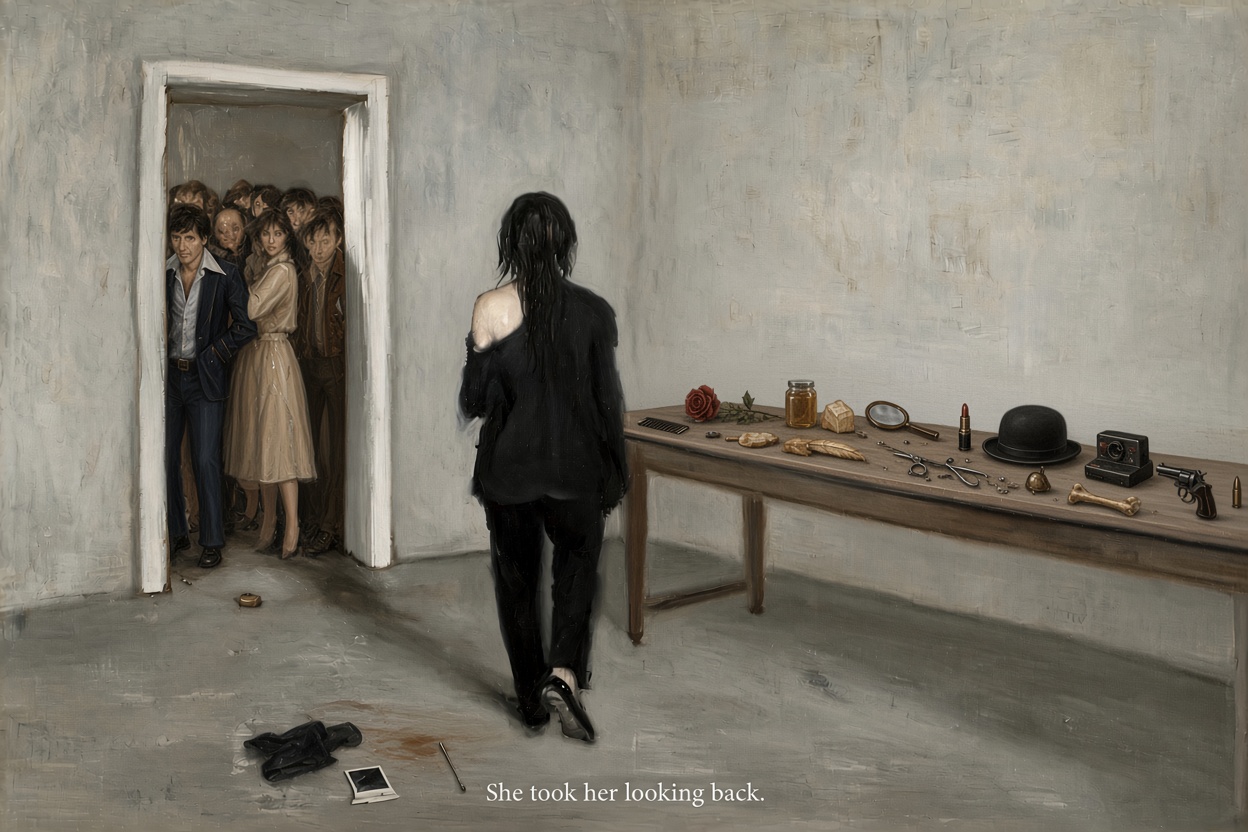
Rhythm 0, Two A.M.
- Eight
At eight the lamps came on in Naples. She had laid it out,
the seventy-two, herself, and left the evening in no doubt:
a hammer, saw, a feather, fork, a bowler hat, a bell,
a rose, a mirror, lipstick, pins, a lamb bone, and as well,
because she chose it, chose it, set it down with her own hand,
a pistol and one bullet lying next to it. She planned
the six hours like a room, and then she walked inside, and wore
black trousers and a black T-shirt, as if for nothing more
than work. Her writing on the card: I am the object here.
Six hours. I take the blame. No stage. No rope. No usher. Clear
floor between them and her. They read the card. They read it slow.
And nothing in the room said no.
- Nine
The art establishment of Naples came, and brought their wives,
with students, and a dealer, and two men up off the street.
They turned her wrist. They raised her arm. They set it in the air
and watched it stay there, held, obedient, and incomplete.
A woman laid a rose across her palm to see it close.
It did not close. That was the whole discovery. And those
who saw went quiet for a moment in a way that no one chose.
No one arrived a monster. They arrived from dinner.
A young man moved a half step in, and stopped, and turned his head
to read the nearest faces for a single word unsaid.
A woman met his eye and told him what to do. He did.
And nothing in the room said no.
III. Ten
After three hours a man came forward with the scissors, and he cut
her shirt apart, and took it off her, and he folded it, and put
it with the rest. Bare-breasted. And the heat came up like weather
out of them and not from her. The collars stuck. The window held.
A wife in a green dress said try the hat. They set it on her head.
The dealer’s wife said write her something. A hand wrote on the mirror
io sono libero, I am free, and pressed it in her palm.
Another took the lipstick and wrote END across her forehead.
A man took Polaroids and dealt them to her like a hand of cards.
They were not cruel. They were curious. They wanted to be sure.
They looked around. They looked around. They looked around, and slow
the trance came on. And nothing in the room said no.
- Eleven
Somebody stuck a pin in her. A woman crossed the floor
and wiped the water from her eyes, and did not do much more,
and went back to her husband. Someone poured a glass of water
slowly over her head. Someone put more pins in. Then a man
who had heard that blood is warm and wanted it, and did not speak,
opened her neck, and bent, and put his mouth to it, and drank,
and got the taste, which is iron, and is nothing, and is hers.
She has the scar. They lifted her. They set her on the table,
spread her legs, and drove the knife into the wood beside her.
Her eyes had stopped their tracking. They had gone somewhere behind.
And once, from that unmoving throat, a swallow. Nothing more.
A latch inside a coat. And nothing in the room said no.
- Midnight
There was one man, a very small man, who came close to her and stood,
and breathed. And that was all he did, for a long time. He stood
and breathed. And she was not afraid of anything that night
except of him. He put the bullet in. He put the pistol right
into her own right hand, and closed her fingers on the grip,
and moved it to her neck, and set his finger on her finger, on
the trigger. And a murmur came up out of the crowd, and then
a man had hold of him, and there was shoving, and were four,
and then were more of them, who were no better than the rest,
and were not sure, and shouted, and got hold, and would not let go.
And the room said no.
And they put him in the street. And then the piece went on.
- Two
At two the gallerist came in and said the six hours were done.
He said the performance is over. He said thank you. And she stopped
her staring, which was all that she had done for six hours, and looked
directly at them, at the actual faces, one by one,
with the only thing she had not set upon that table, having never
meant to lend it, which was not among the seventy-two,
which the permission had not covered, being written to run one way.
She was half naked. She was bleeding. Her hair was wet. And they
were suddenly afraid of her. She took a step. Another one.
And they went out of the gallery and down into the street.
That is her account. It is the only one. I have no proof.
She took her looking back. And nothing in the room said no.
VII. Nine
The shutters went up on the street.
The bakery. The scooter. The news.
Someone swept the floor and someone hosed it
and by eleven the room was rented for something else.
No officer. No file.
No name of any man, or any wife, written down anywhere.
They had gone home together, the husbands and the wives,
and neither asked the other in the car.
They were not asked that day.
They were not asked the next day.
The card went in a drawer, the pistol went home,
the slides went in a box, and the box became the work,
and nothing in the city ever
The event
On an evening in Naples, at Galleria Studio Morra, Marina Abramovic laid seventy-two objects on a table and stood beside them for six hours. She was twenty-seven. She chose every object herself and set them out in a single row: a hammer, a saw, a feather, a fork, a bowler hat, a bell, a rose, a mirror, lipstick, pins, honey, bread, a lamb bone, a carving knife, a scalpel, scissors, a Polaroid camera, a pistol, and one bullet lying beside it. She wore black trousers and a black T-shirt. The card on the table, in her handwriting, told the audience that the objects could be used on her as desired, that she was the object, and that for six hours she took full responsibility. There was no stage and no barrier. She and the visitors stood on the same floor.
The audience was largely the local art establishment and their wives, with students, a dealer, and people who had come up off the street. For the first hours they were careful. They turned her wrist, raised her arm, put a rose in her palm to see whether the fingers would close. They did not close. That was the discovery, and after it the room changed. By her account the women in the gallery mostly told the men what to do to her rather than doing it themselves. After three hours a man cut her shirt apart with the scissors. Someone put the bowler hat on her head. Someone wrote on the mirror in lipstick and pressed it into her hand. Someone wrote END across her forehead. A man took Polaroids and dealt them to her like playing cards. Pins were pushed into her. Water was poured slowly over her head. A man cut her neck and drank the blood, and she still has the scar. She was carried, laid on the table, and a knife was driven into the wood between her legs. One woman crossed the floor, wiped the tears from her eyes, and went back to her husband.
The night’s most dangerous figure was, in her telling, a very small man who simply stood close and breathed. He was the only thing that frightened her. He loaded the pistol, put it in her own right hand, closed her fingers on it, moved it to her neck and touched the trigger. A murmur went through the crowd, somebody seized him, and a scuffle broke out between those who wanted to protect her and those who wanted the performance to continue. He was put out into the street. The performance did not stop. The audience, she says, became more active afterward, as if in a trance.
At two in the morning the gallerist announced that the six hours were over and thanked the audience. She stopped staring and looked directly at them, half naked, bleeding, her hair wet. She says the people still in the room became afraid of her, and that as she walked toward them they ran out of the gallery. That is the ending as she tells it, and hers is effectively the only telling. No arrest was made. No complaint was filed. No participant was ever named. Within a decade the documentation was an artwork and the artist was famous, and not one person who was in that room was inconvenienced for an hour of their life.
Full classification, layer by layer
Oil painting in the manner of Luc Tuymans, painted as if from a poor 1974 colour photograph.
- Genre: narrative ekphrasis. Ekphrasis is verse about a work of art. This is the rarer subtype, performance ekphrasis, because the object is time-based rather than static. You cannot describe it the way Keats describes an urn. You have to re-enact its duration, which is why the form had to become a clock.
- Mode: documentary poetics. The Rukeyser and Reznikoff lineage: verse built from records, testimony, and reportage rather than from the poet’s own experience. Modern practitioners in that line include Solmaz Sharif, Layli Long Soldier, and Mark Nowak. It is adjacent to Forche’s “poetry of witness” but not the same thing, and the distinction matters here. Witness poetry is written by someone who was there. This is secondhand documentary, which carries a heavier evidentiary burden and is why movement VI concedes its single source.
- Prosody: neo-formalist accentual-syllabic. Loose fourteeners, meaning seven-beat lines, which is ballad meter written out long instead of broken into quatrains. Rhyme is slant and impure throughout. This is New Formalist technique, and pairing it with documentary content is uncommon. New Formalism usually runs lyric and personal.
- Form category: nonce, with mimetic constraint. Nonce means invented for this poem rather than inherited. The seventy-two lines for seventy-two objects is a constraint in the Oulipian sense, but where Oulipo constraints are arbitrary generators, this one mirrors its subject. That is the distinction worth naming: procedural form doing representational work.
- Device: incremental refrain with a single inversion. A ballad mechanism. The turn lands in movement V rather than at the end, which is a displaced volta, and the refrain then resumes because the historical event resumed.
- Register: gothic prosody, anti-gothic content. The measure is Poe’s. The worldview is deliberately not. Formally this is a borrowed vessel, and the tension between vessel and contents is the poem’s main stylistic argument.
One-line taxonomy: documentary narrative ekphrasis in nonce fourteeners with incremental refrain.
Sources
— Marina Abramovic, Walk Through Walls: A Memoir (2016), for the artist’s own extended account of the night, including the composition of the audience, the role of the women present, the small man, and the ending.
— Thomas McEvilley, eyewitness description quoted widely in the literature on the work, for the hour-by-hour escalation and the formation of a protective faction.
— Frazer Ward, No Innocent Bystanders: Performance Art and Audience (Dartmouth College Press, 2012), for the reading of the audience as a failed public.
— Tate, MoMA, and Royal Academy collection and exhibition materials, for the objects, duration, and instruction text.
— Susan Sontag, Regarding the Pain of Others (2003), and Judith Butler, Frames of War (2009), for the standing objection to what this poem does.
What a pleasure to read an intelligent text like this one!
Yes. This is a very ambitious and, in many respects, remarkably accomplished poem. It is not merely a retelling of Marina Abramović’s Rhythm 0; it tries to recreate the psychological mechanics of the performance through poetic form. That is its greatest strength.
Overall appraisal
The poem’s most impressive feature is its controlled narrative architecture. The numbered movements—“Eight,” “Nine,” “Ten,” “Eleven,” “Midnight,” “Two,” “Nine”—create the feeling of a clock advancing while simultaneously making the reader experience the six-hour duration. The poem therefore does not simply describe a performance; its structure performs duration. The repetition of “And nothing in the room said no” is particularly effective because it becomes progressively more disturbing.
The central refrain is also the poem’s moral axis. Initially, it means that nobody stopped the participants. Later, after the man with the pistol is removed, it is inverted: “And the room said no.” That tiny alteration carries enormous weight. It establishes that the audience was capable of saying no—but chose not to until the possibility of murder became immediate.
I particularly admire the transition from curiosity to complicity. The line
“They were not cruel. They were curious. They wanted to be sure.”
is chilling precisely because it refuses melodrama. The poem understands that evil here does not initially announce itself as evil. It emerges through incremental permission.
The women’s participation is handled effectively too. The poem avoids reducing the episode to a simple male-aggressor/female-victim dynamic: “A woman met his eye and told him what to do. He did.” That complicates the ethics of the crowd considerably.
Some outstanding moments
The rose is an excellent early image:
“A woman laid a rose across her palm to see it close. / It did not close.”
The experiment is almost innocent, but it establishes the fundamental premise: the woman has become an object.
The most psychologically powerful passage, however, may be the small man with the gun. His behaviour is frightening because he initially does almost nothing:
“He stood / and breathed.”
That restraint makes him more menacing than a conventional violent figure.
And the ending is superb. The transformation occurs when Abramović finally looks back:
“They were suddenly afraid of her.”
The victim acquires agency merely by looking at the perpetrators. The gaze reverses the power relationship.
Where I would be critical
The poem is stronger than its explanatory apparatus.
The sections following the poem—“The event,” “Full classification, layer by layer,” and “Sources”—are intellectually interesting, but they partly explain what the poem itself has already achieved. In particular, phrases such as “documentary narrative ekphrasis in nonce fourteeners with incremental refrain” are useful critical terminology, but they risk making the work feel like it is arguing its own case after the fact.
I would strongly consider separating the poem from the critical apparatus if this is intended for publication. Let the poem stand alone first. A short note about Rhythm 0 could follow it, but the elaborate classification could become an author’s note or critical essay elsewhere.
There is also an interesting tension around “That is her account. It is the only one. I have no proof.” This is intellectually honest and important because the poem is documentary rather than eyewitness poetry. But it also creates an evidentiary problem: the poem is extremely vivid and specific while simultaneously reminding us that its narrator cannot independently verify everything. That tension is artistically productive, but it should remain deliberate.
One technical point
I would revisit the claim that the poem contains seventy-two lines corresponding to seventy-two objects. The supplied poem does not obviously present itself as a straightforward 72-line poem, and the numbering is unusual enough that a reader may become distracted trying to decode it. If the 72-line constraint is fundamental, I would make the relationship unmistakable—or remove the explanatory claim.
Best
Supratik
Supratik,
Thank you. This is the most useful reading the poem has had, and I want to say why rather than just say it.
You identified the thing I was actually attempting, which almost nobody does on a first read. The structure performing duration rather than describing it was the whole gamble. If that had not landed, there was no poem, only a report with line breaks. That you named it before praising anything else told me the machinery was working from the inside.
You also caught the two moments I most wanted caught. The rose that does not close is the hinge of the entire piece, and it was written to look innocent so that the reader is complicit in the experiment before understanding what has been established. And the small man who only stands and breathes is the one figure I resisted dramatising, on the principle that proximity and intent read as more dangerous than injury. Your reading of him is exactly right.
Now to your criticisms, both of which I accept.
On the apparatus: you are right, and I think you are right in the strongest sense. The poem does argue its own case after the fact, and a poem that needs to do that has already conceded something. The classification was written as working notes and then promoted to a document section because it was interesting to me, which is not a reason. For publication I will separate them. The poem stands alone, a short factual note on Rhythm 0 follows it, and the classification goes elsewhere as an essay or nowhere at all.
On the evidentiary tension: it is deliberate, and I am glad you flagged it as productive rather than as a flaw, because it is the hinge the whole piece turns on. The account this poem draws from is essentially singular. Her memoir is the only detailed telling by anyone who was in that room, and even it misdates the year. So the poem is at its most vivid precisely where it is least verifiable, and I decided that a piece about a woman being made into an object had no business quietly claiming an authority it did not have. Hence the concession inside the poem rather than in a footnote. But you are right that it must remain deliberate, and if it ever starts functioning as insurance rather than as an admission, it should come out.
On the technical point, I have recounted and the constraint does hold. Movements one through six are twelve lines each, seventy-two in total, one per object. Movement seven sits outside the count on purpose, because the morning after is not part of the work.
But your objection survives the recount, and it is the better objection. A constraint that is arithmetically true and perceptually invisible is doing no work for the reader. Two things obscure it: the seventh movement makes the total look like eighty-five, and one line in movement three carries an italic phrase that reads as a break. So the choice is to make it unmistakable or to stop claiming it. I am inclined toward the second. If the form is working, it works whether or not the reader can audit it, and the claim was always more useful to me than to anyone reading.
It is worth adding, for perspective, that the only other memorable response I have had to the piece came from a friend, who studied the painting for a while and asked whether that was Scarface in the doorway. I am still deliberating on whether to reply, No, it’s Al Pecino.
On which note, I am posting a poem today called Passenger, and I am taking your advice with it. No apparatus at all. It uses a fairly complex structure, and this time I am letting it stand or fall on its own without a word from me about how it is built. I would very much value your reading of it, if it interests you.
Thank you again for the time this clearly took. Feedback that engages with what a piece is trying to do, rather than with what the reader would have written instead, is rare enough that I do not take it lightly.
With real appreciation,
KJS