
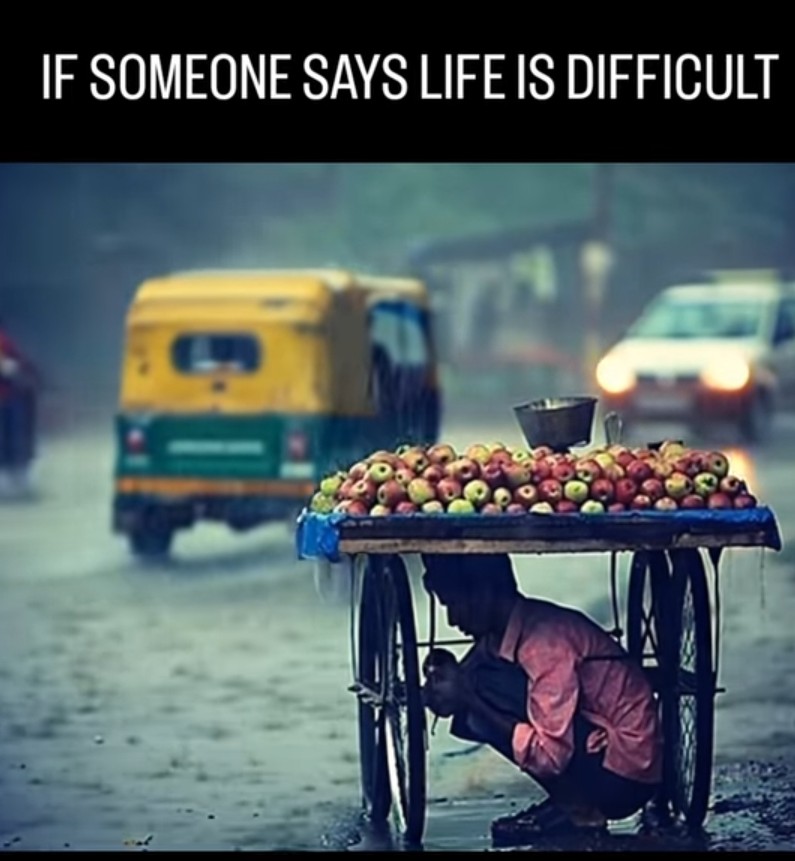
What are we selling, or underselling
poverty or apples, is that the question?
A life whose fruition is not so tender,
a trade disguised as hunger,
a dignity bent low
beneath the dripping rim of a cart
out of rhythm, out of flow.
We sell sweetness,
but undersell the storm endured,
the countless mornings of lifting,
pushing, calling out to strangers
who seldom meet our eyes
still the ears hear the cries.
And yet the drizzle comes to
dampen his fire,
to deaden his hope,
to dull his spirit, to extinguish
the small flame of comfort.
It tries to hush the means of need,
to lull the struggle into silence,
to overawe his resolve with thunder.
But he remains, in quiet defiance,
letting the wind attempt to quieten him,
to shush his voice,
to soft pedal his courage,
to still his movement,
to tongue-tie his hunger.
Though each raindrop falls like a thought,
in the silence between traffic horns—
a pin drop moment of endurance
that no gale can erase.
What is the price of resilience?
What is the weight of a dream
measured against the weight of rain?
Society takes the fruit,
but leaves the man in shadows,
huddled in silence
where no coin’s noise can reach.
Life is difficult—
but more challenging still
is the quiet bargain struck
each day:
to stand in the flood,
not utter a word to
the western world,
still believe in tomorrow’s buyer,
to drive through hunger
without brake, without gear.
Monsoon again? For some countries, the soul of the village keeping others cheaply fed, working for a pittance, is the small market trader, cart pushed into place and laid out with anything needed and sellable. You poem very descriptive and evocative, with survival depending on good wares, good local or passing through folk, good days. In many instances, ‘there, but for someione’s grace, go I…? Yes, as you so rightly say, everything is about comparisons and expectations, presented as a compassionate write.
Thank you so much, Trevor, for such a perceptive and layered response. You’ve touched upon the very heartbeat of what I was trying to convey—the fragile economy of survival, where the monsoon or the marketplace can decide the fate of lives. The image of the small trader, pushing a cart into place with hope stacked alongside the wares, is indeed the unsung metaphor of resilience.
I really appreciate how you brought out the sense of “there, but for someone’s grace, go I”—that deep recognition of shared vulnerability and chance. Comparisons and expectations often blur into each other, and in that haze lies the essence of compassion: to see ourselves in another’s struggle.
Your words have added another dimension to the poem—thank you for engaging with it so thoughtfully.