Dulwich Society’s retired architect
presses his demolition finger, and,
in before and after sequences,
Victorian houses flashing by in sepia,
become abstrusely metamorphosed
into brochure-like images,
leaving smidgeons of infancy
lingering on after each new click.
Real estate’s exhumed remains,
rising up to momentarily strengthen
load-bearing beams, struts, and ties,
propping up the innermost
mausoleums of childhood minds,
subjected to instant revision by that
cruel guardian of Man’s sanity
– actual reality.
Ancient brick becomes coloured steel,
windows, one glossy glass wall, reflecting
only the darkness of a callous age, having long
since desecrated the axiomatic graves
they replaced without permission
or objection.
With the doors to four floors
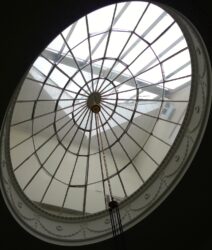
irrevocably vandalised, and cupola heads
emotionally expurgated
– nostalgia
suffers structural collapse, and
public closure, in the interest of
mental safety.
Goth:2024
I think in every town and every city in every country this happens. To improve our lives they destroy buildings and replace them with something nowhere near as good. Thirty years from now, when they destroy the buildings that are nowhere near as good, I wonder what they’ll replace them with.
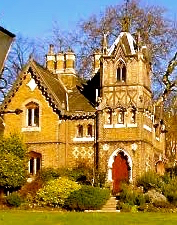
They’ll probably replace them with yellow London brick mock Victorian detached houses! One can understand redelopment to war damaged areas, and Dulwich and Upper Norwood suffered many long-range V1 (doodlebugs) and V2 hits due to the War Office changing the map coordinates to spare central London, making the incoming projectiles fall short, but many untouched architecturally one-off houses were lost to history. The next house up from us, Lowood, suffered damage from a nearby V1 hit, and was never lived in again, and their extensive overgrown woods and gardens with fountains and outhouses became our play-area growing up. We had many bombsites (that we called ’emps’ if house stuctures left) to play in. Thanks Turlough!
Here in Bulgaria we have different story but with the same ending. We have many old Communist era buildings which the planners want rid of because of what they represent. But many of them are very interesting if not spectacular to look at or even visit. They pull them down, or often just leave them to rot through neglect, and build the sort of things you’d get in Western Europe but using poor quality materials. There’s also a massive depopulation problem here. On the down side of that there are countless abandoned houses, schools and factories but on the up side there is no homelessness. On an even upper up side many abandoned villages and the roads leading to them have been reclaimed by nature.
In the mid 1980s I lived in Gillingham in Kent (another wartime victim town because of Chatham dockyard) and I worked near St Paul’s Cathedral so I used to travel on the King’s Ferry commuter coaches every day. They used to pass through places like Dulwich and Black Heath so I know the sort of buildings you’ve described.
As soon as I read your description I thought it was a bomb damaged house as I remember many such near where I grew up. we lived near Biggin Hill so hitlers planes often thought our estate was the airodrome. Later the V1s and v2s apparently thought the same. Actually our house was never hit and anyway Kit and I were evacuated first to Devon then to Birkdale.
Well, the next house up from ours was unlucky, but ours survived. Yes, my sister and I was born on Arran where our older brother was evacuated, not allocated, but due to the fact our father, a captain (died a major) in the Royal Marines (ex Chatham barracks) was posted there (officers could take their wives) to help train the troops in beach landing, as the beaches on Arran were geologically the same as those in Norway, water depth etc., where D-Day was originally to start from. But Montgomery’s 7th armoured division, the Desert Rats had broken into Europe through its ‘soft underbelly’ Italy, and the diversion of German troops made Normandy feasible and more desirable for the invasion. Our house in Dulwich was boarded up with sandbags till the war ended, when we all, minus my father, who had fallen at Normandy, returned.
With those moves, curious to know how you ended up in Wales?
Well, the answer to your final query is that in part of my assorted mispent life Trained as a nurse and then worked for about a year on a dairy farm in Shropshire as I wanted to escape to countryside. My boss mentioned Wales from time to time and one day I said I’d never seen a mountain. There aren’t any in Kent. He said I should take 5 consecutive days off and he’d give me a lift to Shresbury. I walked from Perthmadog into the Welsh countryside and fell in live with it. From then on I went back to it as often as I cound and eventually when I retired I quit Exeter where I had been running an international centre and teaching english and other languages. Went house hunting with a friend and found this delightful stone very old house where I have been ever since.
What long winding paths, sometimes from sharp crossroads turns, sometimes back from less happy cul-de-sacs, but even on happy memorable detours, most of us take in life, and where we finally roost when retired, even more unpredictable, often work or partner related! You’ve had several staging posts on your meanders. How you travelled to Perthmadog from Shrewsbury to then get that first sight of that beautiful area you have settled in, is a mystery. Holidayed many times around the Snowdonia area in middle life, (plus stationed at Sennybridge to the south for many years in my adventurous youth), so know how happy you must be to live there, what for 30 years it must be, now. Thanks for that, Daffni!
Thanks Trefor. Pity I didn’t check my spelling but could have been worse. 1985 I came here so I think that makes 45 years. My arithmetical powers are non-existant but think that means 5o years nrxt july. But you are right; I am very happy in my lovely old house with my delightful little dog and four ducks.