
Lingo Bingo
I was born a Smoggie, one of that unique race of people emanating from Middlesbrough in the North East of England where the local dialect is a combination of Yorkshire, Viking and bronchial problems brought on by exposure to excessive industrial pollution. Until I was nine years old I spoke with an accent similar to that of comedian, Bob Mortimer and a dirty work shirt was a derty werk shert, though if it was very derty it would be described as acky. But, despite the beautiful psychedelic sunsets and unlimited free supplies of nitrogen oxide laid on by the nearby steelworks and petrochemical plant, my parents decided that we should leave the area and my native tongue virtually disappeared.
The intermediate stage of my childhood took place along the theme of sectarian violence. The North of Ireland in the late sixties and early seventies was a great place to live if your hobbies included spotting endless coils of barbed wire, threatening military vehicles and burnt-out buses. And then there were the petrol bombs. We only had the four-star stuff in those days. The kids of today are spoilt, in my opinion, with their unleaded high-performance high-octane cocktails of highly flammable liquids and their Nectar points, though the extinction of the glass milk bottle in recent years must be quite trying for them. You’d think that having one foot either side of the Peace Line our lives would have been extra safe, but the reality was the absolute opposite. My family, built around a nucleus of an Irish Catholic father and an English Protestant mother, was a cause of suspicion for everybody, including a small community of Hindus in Ballymena. Speaking with an accent from ‘the other side of the water’ did little to help. So in a relatively successful attempt at staying alive, I quickly learnt to talk like the Reverend Ian Paisley and continued to do so until I was twelve, at which point the parents’ nomadic habits kicked in again.
A return to the North of England was our next step. Sympathetic to our borderline refugee status, Leeds City Council allocated us a maisonette above the North Eastern Gas Board showroom in a concrete shopping centre that wouldn’t have looked out of place in the portfolio of a firm of Soviet Bloc brutalist architects but actually stood in the heart of a dodgy council scheme the size of Azerbaijan. There, on Seacroft Estate, people knew that British soldiers weren’t welcome in the North of Ireland so consequently the people of Seacroft Estate weren’t exactly opening bottles of Champagne and handing out cigars to celebrate the arrival of twelve-year-olds who spoke with North of Ireland accents. The local comprehensive school at which I was hurriedly enlisted bore an uncanny resemblance to the school in the classic Ken Loach film, Kes, and by the Thursday of my first week there, I was talking like Billy Casper, the film’s main character. Not an attractive way of speaking but the other available option of having broken teeth and fingers didn’t strike me as being very attractive either.
A couple of decades later, at the conclusion of a Channel Four Television documentary series about British towns, viewers voted Middlesbrough the worst place to live in the whole country. Almost simultaneously, the Times newspaper published its first annual league table for secondary schools and my old seat of learning in Leeds finished absolutely rock bottom. So, during my formative years, my parents had moved me from the worst town in Britain to the worst school in Britain, via a war zone. I take pride in having survived this experience physically and mentally (though in both cases, only just); my ability to adopt a new way of speaking at a crucial time being a crucial component of this skill.
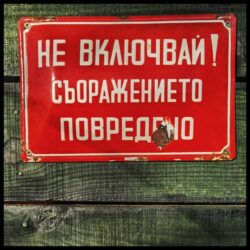
Nowadays I live in a place where the people are harder to understand than even Geordies are. Here in Bulgaria we haven’t just a different language but also a completely different alphabet. We write Newcastle Brown Ale as Нюкасълска Кафява бира, but we never drink it because it’s not as strong as the purely organic stuff we have here of our own.
Cyrillic script is a writing system invented by a student of local boys, Saints Cyril and Methodius, and first used in Bulgaria in the ninth century. Since then it has evolved and expanded across much of Eurasia to the extent that it is now used by more than 250 million people. Sometimes it is erroneously referred to as the Russian alphabet but really it is ours, definitely ours! Those boys in Moscow merely stole it, fiddled about with it a bit and later forced it upon the occupants of their vast totalitarian empire.
A huge benefit of using this alphabet is its phonetic nature. Every letter is pronounced the same way every time. So if you know your Cyrillic letters you can read the writing and if you can read the writing you will notice that a fair few of our words are the same as, or similar to, words in Western European languages, and you’re well on your way.
This is the complete opposite to my partner’s native language, French, where there seems to be approximately twenty silent letters in the alphabet and twenty more that have a totally unpredictable sound, and all emphasis is done through hand gestures, shoulder shrugging and the adjusting of berets. I’ve discovered that the ‘Learn French with Marcel Marceau’ DVD is as good a teaching tool as any.
In Bulgarian there is no single word for the definite article. Instead they add a suffix to the noun and a different suffix is used depending upon whether the noun is the subject or the object of the sentence. And if the noun requires an adjective, the suffix is applied to the adjective rather than the noun. Oh, and these suffixes vary with the gender of the noun and whether or not the singular or plural applies.
A wee example: Priyatel means friend, Priyatelka means female friend, and Priyatelkata means the female friend, or the girlfriend.
Determining the gender of a noun can be tricky too. The word for a crowd of men is masculine. The word for a crowd of women is feminine. But the word for a crowd of women, even if there are a million of them, will become masculine if there is one man amongst it. The current ideas on people deciding for themselves which gender they wish to identify as will never be successful in Bulgaria because the language would no longer be able to function.
Our verbs come in aspect pairs, they being one imperfective and one perfective. My way of simplifying the complexity of trying to explain this is by taking the example of drinking a glass of wine for which there is one verb for doing the drinking on a continual basis and a completely different verb for if you are only going to do it once (as if anyone would ever only have one glass of wine) or if you’ve finished drinking it. On top of this the verbs are conjugated to include the informal or formal for the second person bit, like they do in French with their shoulders and little moustaches.
And Bulgarians use the same word (med) for honey as they do for copper.
And saying I haven’t got nothing (nya-mam neesh-toe) is grammatically perfectly legal.
And the majority of Bulgarians have strong regional accents.
And… And… And…
Oh, it’s hard work!
But the good news is that I have 6.5 million teachers. Every single Bulgarian seems to want to help me, even though some of them haven’t quite got to grips with the subject themselves. Many immigrants here still insist upon shouting in English (or muttering in French) to make themselves understood but since my arrival on these shores I have always had a go at the language and the locals seem to appreciate it.
I feel an enormous sense of achievement if I get it right and there are usually smiles all round, or even laughter, when I get it wrong. Simple mistakes with a single short word, or even just a wrong syllable, can be hilariously disastrous. In the past I have wished people a happy new garden instead of a happy new year and I have asked in a shop for food with cats instead of food for cats. After a five-minute discussion with a waiter in a restaurant, Priyatelkata and I once sat smugly congratulating ourselves on our command of the native tongue as we waited for our traditional village salads to be brought to our table and then crestfallen when we were each presented with plates laden with half a spit-roast chicken buried under half a boiled cabbage immersed in half a litre of boiled sunflower oil… and chips.
Learning and speaking the lingo of our adopted home is very hard. After eight years living here, we are probably twenty-five percent fluent, so in everyday situations we tend to get by. The problems arise when we are discussing with professionals the health of our own bodies, or of our car or animals. When undergoing a limb amputation, for example, for all aspects of the procedure, particularly the preoperative discussions, the level of accuracy needs to be significantly higher than twenty-five percent. On these occasions Bulgarian friends are more than willing to accompany us, either to help with translation or to see the blood and gore.
So far, this business of adopting a new language has been much more difficult than it was changing accents to avoid being murdered in school playgrounds in England and Ireland way back in my juvenile past. I can still lapse into those old accents. I still speak mostly in some sort of weird mixed up combination of them all. Although Priyatelkata’s first language is French, her father was Algerian, her stepfather was Polish and her maternal grandparents spoke only Breton. We try to speak to each other in Bulgarian but other lingos are available in our house, so I can’t tell you what you would get if ever you came to visit us.
As difficult as efforts are at being multi-lingual, this is by no means a rant or a rave or even a polite complaint. It’s simply an explanation of the labour of love of my life that may have started out a long time ago as a labour of clinging on to my life.
What a proud and interesting history you’ve lived and can draw upon for ‘authentic’ writing material when sharing it with others, Turlough! Only three years in Belfast, but you perhaps acquired your Dad’s dialect too (in a discussion with friends recently, we voted ‘Belfast girl’ as one of the sexiest dialects around!). Bob Mortimer’s a favourite of mine, so know your present voice tag.
You certainly moved about a lot, but I’ve found in life that, in spite of the interupted schooling, those who’ve experienced it (like military children) do not suffer any problems with language and its expression, quite the opposite, it’s often richer and more varied, and more interspersed with humour, especially in written form. And you’re proof of it, or at least a good example! Here, very educational too, learning some interesting facts about the very complex Bulgarian language, especially when having to learn and use it in colloqial form. When you’re, like me, so fluent, you do things like dream in the new language, that’s when confusion and conflict occurs, but it also enriches you due to the constant revisiting of word-meaning, helping to be more accurate with word choice. Old age wiseness, doesn’t include language, I’m afraid, as memory with its forgetting and loss of retrieval, reduces the experience advantage. Thanks for another entertaining and educating read, here based mainly on language, You have a rare talent able to tap into and express with balance, the interesting life you’ve lived, that you lead.
Now I am even more convinced you should write your autobiograpgy [preferably not in Bulgarian though].
Years ago when I was on a course in Leningrad I decided I wanted to go to the theatre, The Pushkin Theatre was just round the corner from my hotel and I read the advert outside it and decided to see my fair lady in russian. I presented myself on the right evening and heard there were no seats but I could stand till the programme begab and if there was a spare seat I could have it. In due course there was and I sat there. When the show started it turned out firstly that MFlady was another night and this night was a Bulgarian pop concert. I can’t stand pop but this was fascinating as the introductions were all done in Bulgarian with built in jokes. Bulgarian is very like Russian.
Some time later i did se mfLady in Russian by attending the performance given by students as part of an end of term exam. It was wonderful.
Oh I envy you Daffni. I had big hopes of travelling to Ukraine. Romania’s border with them on the Black Sea coast is only 500 kms from where I live. I think I’ve missed the boat now, though I’m hoping to do a bus trip to nearby Moldova in the not too distant future.
Bulgarian pop concerts are always interesting affairs, no matter what your taste in music. And of course the Bulgarian language is very like Russian. I can understand bits of the language in all our neighbouring Slavic countries, and they all stole the Cyrillic alphabet that we created. If only alphabets were copyrightable!
Many thanks for the kindness of your comment.
Ah, thanks very much for the kind words in your comment Gothicman.
We didn’t actually live in Belfast but in a town called Ballymoney which was halfway along the road from Belfast to Derry. The people of Ballymoney in North Antrim have the same accent as those Belfast folk, though maybe a little louder.
My lifetimes’s experiences were not all enjoyable ones. Some were quite terrifying at the time. But I agree with you that collectively they enrich the mind. I find it much easier to write about traumatic problematic things than nice things. A few years back I wrote a piece for a travel company about my walking holiday in Bosnia. They were delighted with it and published it in their quarterly bulletin posted out to all their clients. They asked me to write another one about a trip I did with them in Bulgaria’s Rodopi Mountains but the only words I could muster were ‘nice’ and ‘beautiful’ so I failed the task.
I’ve a pile of stories written and head full of ideas for the future so I’m sure I’ll be posting some more on UKA.
I’m not surprised you’ve had some success, and if you continue contributing here, though still too meagre for some, with you and Daffni submitting quality work and interacting with comments, new members might be tempted to enjoy the benefits of writing and the broadening, sociably inclusive, atmosphere obtainable here.
I wonder how we could attract more members. It’s a shame there aren’t more and surprising too as it’s easy to use and it’s free.
I understand there was a demise and a relaunch. How can we get the pre-demise members to return?
I’m certainly going to stick with it.